Daily Catholic Lectio
Wed, 19 March ‘25
Saint Joseph Spouse of Mary, Solemnity
2 Samuel 7:4-5a, 12-14a, 16. Psalm 89. Romans 4:13, 16-18, 22. Matthew 1:16, 18-21, 24a
Her Husband Joseph
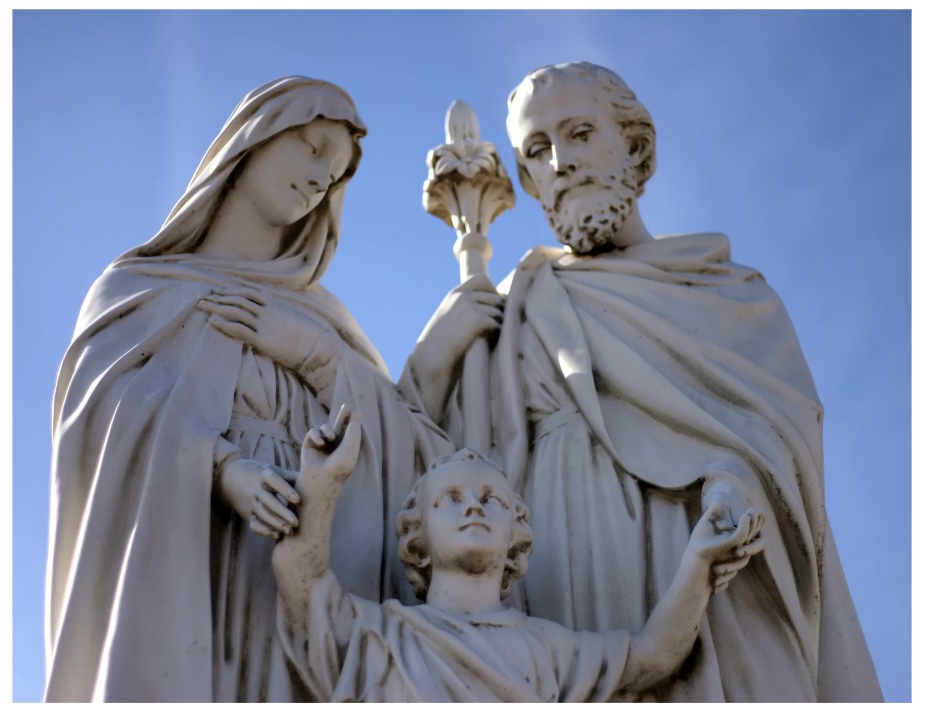
Today, we joyfully celebrate St. Joseph as the spouse of the Virgin Mary. The evangelists introduce Joseph only in connection with Mary and Jesus.
In the liturgical calendar, St. Joseph is commemorated on two days: (a) March 19 – St. Joseph, the spouse of the Virgin Mary. (b) May 1 – St. Joseph, the patron of workers.
One aspect is related to family, and the other to work or vocation. As human beings, we all hold these two fundamental dimensions: family and work. Through our family, we take root in this world; through our work, we spread our branches. Those who marry belong to both their birth family and the new family they establish.
If we reflect deeply, our family and work are what truly matter in our lives. Everything in between does not significantly impact us.
Today, let us reflect on our family relationships and work life. Our families face challenges—misunderstandings between spouses, tensions and conflicts between parents and children, bitterness, jealousy, and hostility among siblings. Similarly, our professional lives are often filled with struggles—job dissatisfaction, unemployment, job insecurity, inadequate wages, competition, stress, transfers, dismissals, and exploitation.
Through the four dimensions (faces) of Joseph revealed in the Gospels, let us consider the lessons he offers for our family relationships and work life.
1. A righteous man – righteousness rooted in mercy
When Matthew introduces Joseph to his audience, he describes him as “Joseph, her husband, a righteous man.” However, this phrase may sound alarming to the reader. Joseph discovers that Mary is pregnant. Mosaic Law addresses adultery but does not specifically mention premarital pregnancy. While Joseph receives divine clarification through an angel, others remain unaware of this. Initially, he considers quietly divorcing Mary. Perhaps, he even contemplated breaking off the engagement altogether. This was the common approach among young men of his time.
However, Joseph could not bring himself to do it. Instead, he accepted Mary. Here, Joseph’s righteousness was not merely legalistic or customary but deeply rooted in mercy and the fulfilment of God’s will.
Today, we often cling to laws and customs. However, laws themselves are incomplete. For example, marriage laws dictate procedures for separation and alimony but rarely focus on reconciliation and healing. Legal systems and societal norms impose numerous rules upon us, yet when we need help, neither society nor the world comes to our aid. Moreover, legal righteousness is based on give-and-take, whereas mercy-based righteousness transcends laws.
2. A man of deep silence
Joseph does not utter a single recorded word in the Gospels except for one: “Jesus.” Matthew states that after the birth of the child, “he named Him Jesus.” According to Jewish tradition, the father must whisper the child’s name into its ear during the naming ceremony. Apart from this event, Joseph remains silent in all other Gospel narratives. His silence speaks volumes.
In today’s noisy world, silence and inner peace are more essential than ever. Joseph’s life did not unfold as he had imagined. At every stage, he faced an unexpected turn. When life’s realities become overwhelming, maintaining silence is a virtue.
Many family and workplace conflicts arise because of our words. Words spoken in anger can leave lasting wounds and cause irreversible damage. As children, we learn to speak. As we grow, we must learn to remain silent.
3. A man of action
Throughout every Gospel account, Joseph is constantly taking action. When he learns about Mary’s pregnancy, he ponders a solution. Once he receives divine clarification, he immediately acts. He accepts Mary. He travels to Bethlehem. When there is no room at the inn, he immediately finds another place. He moves to Egypt, then to Judea, then to Nazareth, then to Jerusalem. His feet are always in motion.
Thinking and planning are good, but if they do not turn into action, they remain mere dreams. If I decide, “My room should be clean!” then I must immediately clean it. Thinking alone does not tidy the room. The shorter the gap between thought and action, the greater the success. Many people fail because the gap between their thoughts and actions is too wide.
4. A man who marvels or wonders
When faced with unanswered questions, Joseph’s first response was silence. His second response was wonder.
During the event where 12-year-old Jesus goes missing and is found in the Temple, we witness Joseph’s ability to marvel. Luke describes the scene:
“When His parents saw Him, they were astonished. His mother said to Him, ‘Son, why have You treated us this way? Your father and I have been anxiously searching for You!’ He replied, ‘Why were you looking for Me? Did you not know that I must be in My Father’s house?’ But they did not understand what He was saying to them.”
For Joseph, the term “Father’s work” likely meant carpentry. But when Jesus referred to His Father’s work, Joseph was puzzled. Yet, he remained silent. He did not question, “Why is He saying this?” Instead, he marvelled, “How is He speaking like this!”
Moving from a life full of question marks to a life full of exclamation marks is maturity.
How did Joseph cultivate these four qualities?
Today’s Scripture readings provide the answer: Faith, Hope, and Love.
In the first reading, King David wishes to build a temple for God. However, God broadens David’s vision of faith by promising to build a house for David instead. David embraces this promise with the eyes of faith.
In the second reading, before discussing Abraham’s faith, Paul writes, “Abraham was hoping against hope!” Patience and endurance enable a person to hope.
In the Gospel reading, Joseph sets aside his doubts and accepts Mary. His decision is a manifestation of his love for God and for Mary. God intertwines divine love with human love.
Today, as we celebrate St. Joseph, let us pray for his intercession so that we may grow in faith, hope, and love.
Fr. Yesu Karunanidhi
Archdiocese of Madurai
Messenger of Mercy

 Yesu Karunanidhi
Leave a comment