Daily Catholic Lectio
Second Sunday of Lent
Genesis 15:5-12, 17-18, 21b. Psalm 27. Philippians 3:17-4:1. Luke 9:28b-36
Look up!
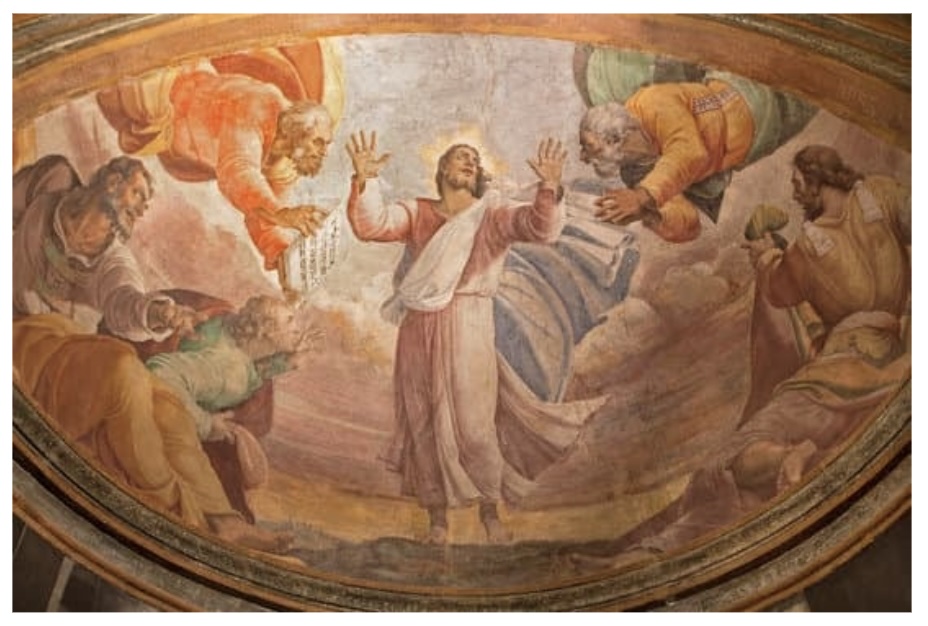
During Lent, our eyes are fixed on Calvary. To understand Calvary, we must also understand the other mountains Jesus climbed. Last Sunday, we met Jesus on the mountain of temptation. Today, we meet Him on the mountain of transfiguration.
The Gospel of Luke presents Jesus’ Transfiguration as a prayer event. By understanding its key elements, we gain deeper insight into our own faith journey.
At the outset, let us understand the key elements of the Transfiguration event:
(1) The mountain: In the Bible, mountains symbolize places of divine encounter. Climbing a mountain is difficult—just as drawing closer to God requires effort.
(2) Prayer: Luke portrays Jesus praying during His baptism, temptation, and now transfiguration. Major life events require prayerful preparation.
(c) A changed appearance: Luke describes that Jesus’ face changed in appearance.In biblical tradition, the face symbolizes divine revelation (e.g., Moses’ radiant face in Exodus 34:35). Transformation is both external and internal—what we experience within changes how we appear to the world.
(d) Moses and Elijah. Moses represents the Law, and Elijah represents the Prophets. According to the Old Testament, Moses does not enter the Promised Land (cf. Deut 34). But, in the New Testament, Moses enters the Promised Land here. They discuss Jesus’ coming passion, death, and resurrection, showing how He fulfils the Old Testament. Thus, Jesus becomes the fulfilment of the Law and the Prophets.
(e) The cloud in the Bible clouds symbolize God’s presence. Just as a cloud covered the Tent of Meeting in Exodus (40:34), here it signals that God is present with Jesus.
(f) The voice from the cloud: “This is my Son, my Chosen One. Listen to Him!” The voice confirms Jesus’ divine identity and calls the disciples to obedience.
What is the significance of this event?
For the disciples, this event expanded their vision. They saw that Jesus was greater than Moses and Elijah. Their faith was strengthened. They received a clear command: “Listen to Him!”
For Jesus, this event was a moment of deep prayer. He heard the Father’s voice. He reaffirmed His mission.
First reading: Abraham’s divine encounter
God calls Abraham out of his tent: “Look up at the sky and count the stars—if you can!
So shall your descendants be.” Faith enables us to see the unseen. Abraham believed in what his eyes could not see—and God made a covenant with him.
Second reading: A heavenly perspective
St. Paul speaks to the Philippians about two types of people: Those who oppose the Gospel; Those who live by faith. Paul reminds us: “Our citizenship is in heaven. We eagerly await a Saviour from there—Jesus Christ—who will transform our lowly bodies to be like His glorious body.” Just as Jesus was transfigured, we too will be transformed.
What are the lessons for us?
(1) Manifestation
Many modern leadership philosophies speak of ‘manifestation’— That which is meant for you will be revealed. Mother Teresa came to India as a teacher but later discovered her true mission—to serve the poorest of the poor. Abraham’s calling was not just to remain in a tent but to become the father of many nations. We must ask: “What is being manifested to me about my life?”
(2) Action
Abraham leaves his tent. The disciples climb the mountain. To experience transformation, we must be willing to act and move forward. Remaining in the same place, doing the same things, will never lead to new results. Sin keeps us stuck; grace moves us forward.
(3) Looking up and looking down
Abraham looks up at the stars but then must walk the journey ahead. The disciples climb up the mountain but must also descend back into daily life. We are called to seek God’s presence and then bring that experience into our relationships.
Psalm 27 proclaims: “Your face, O Lord, I seek!” May we seek His face and allow His light to guide our journey.
Fr. Yesu Karunanidhi
Archdiocese of Madurai
Missionary of Mercy
 Yesu Karunanidhi
Leave a comment