Daily Catholic Lectio
Sun, 2 February ‘25
Fourth Sunday in Ordinary Time
Presentation of the Lord in the Temple, Feast
Malachi 3:1-4. Hebrews 2:14-18. Luke 2:22-40
God who is Dedicated
Today we celebrate the day on which the parents presented the Child Jesus in the temple at Jerusalem as an offering. This day is also observed as the holy day of those who have consecrated themselves to the Lord and His service. With today’s observance, the season of Christ’s nativity ends. In this turning point, as we recall Jesus—lifted in our hands like a burning candle and revealed as a light to the unfaithful—we are reminded of our daily need to consecrate ourselves to God.
The first reading is taken from the book of Malachi, the final book of the Hebrew Bible. Malachi proclaims, “The Lord you seek will suddenly come into the temple.” Three points stand out here: (a) The Lord’s coming to the temple will occur suddenly. (b) The Lord Himself will come into the temple. (c) Only those who seek the Lord will be able to behold Him.
When the Babylonians invaded, the city of Jerusalem was laid waste. With the destruction of Jerusalem and its temple—and the people taken away as captives—the presence of the Lord and the temple departed along with them. From that day on the people eagerly awaited the return of the Lord’s presence. Today, behold, the Lord’s presence is again entering the temple. The prophecy of Malachi is fulfilled. Simeon and Anna stand as the symbols of those who waited eagerly; they now behold Him.
In the second reading, the teacher of the Song of Songs—addressed to the Hebrews—writes: “In the service of God, He is not only a chief teacher endowed with mercy and faith but is to be, in all things, like a brother to his brethren, purifying the sins of the people.”
Jesus’ role as the chief teacher begins with His humble submission. Like all children, even Jesus—though He is God—is offered to God.
The Gospel reading presents the events of that day, which hold three significant aspects for both Jesus and His parents: (a) It is the day on which, after the child’s naming, the mother is purified. (c) It is the day of the child’s circumcision (in some places noted as the eighth-day circumcision). (c) Since every title of man belongs rightfully to the Lord, it is the day on which the child is redeemed by sacrifice.
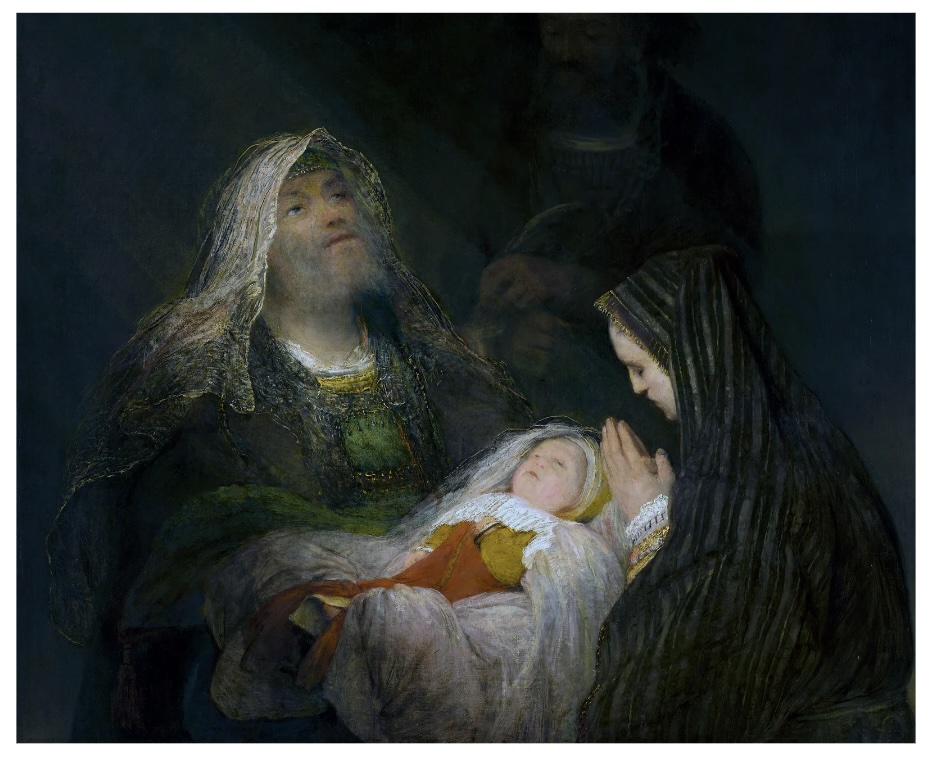
Simeon and Anna stand in the temple. In the twilight of life, they receive the honour of carrying the radiance of humility in their hands. Lifting the child in their arms is an art.
(a) Simeon, in the eyes of the Child Jesus, sees his own eyes reflected. Through this, he discerns the purpose of his life. With that purpose fulfilled, he is ready to depart in peace.
(b) When Simeon holds the child in his arms, he perceives how this Child will be transformed—becoming the cause of both the downfall and the uplift of many among the people of Israel. He understands that the power to transform resides within Him.
(c) Simeon feels the touch of the Child in his hands. At that very moment, as he marvels at the Child’s strength and the power He embodies, he rejoices at the fulfilment of his long-cherished hope.
Life lessons for us:
(a) Patience
Every day, countless children were brought into the temple at Jerusalem. Yet Simeon was not overwhelmed with joy at the sight of them all—he waited. He waited for the prompting of the Holy Spirit. Only those who nurture patience in their hearts can truly wait. Today, we often lose our patience; waiting is dismissed as unnecessary. As a result, we may fail to discern the promptings of the Holy Spirit. In Spes non Confundit, Pope Francis says, “Hope and patience are inter-related.”
(b) Praise
Simeon praises God and speaks to the parents about the Child. One who is filled with God always offers praise to Him and speaks honestly about others. How often do we praise God today? Is our conversation about others sincere, or does it lean toward negativity?
(c) Simplicity
Jesus’ parents presented the Child as an offering using what they had—offering Him with two pigeons—since they could not afford an ox or a goat. Their poverty became their greatest treasure. This illustrates the nearness God shows especially to those who are weak. The call “Do not forget to help the poor” echoes in the initial sacred message (cf. Colossians 2:10).
(d) A God-centred Life
The Child, dedicated to God, begins a life with God as the centre. What is the centre of our lives? Is it our position, our identity, or is it God?
(e) Purpose
Simeon explains to the parents the purpose of the Child’s life. From the day the angel announced it, Mary regarded all that transpired as unfolding according to divine order. God reveals the purpose of our lives at the proper time. While we may set goals, the ultimate purpose of life is determined by God. When our aims and His purpose align, it is the essence of true goodness.
(f) Daily Consecration
Every moment of our lives calls us to be an offering. A heart that consecrates itself clings to nothing for its own sake. In such a heart, either a kind of freedom or a kind of bondage takes root.
Happy Feast of the Presentation of Our Lord Jesus!
Fr. Yesu Karunanidhi
Archdiocese of Madurai
Missionary of Mercy
 Yesu Karunanidhi
Leave a comment