Daily Catholic Lectio
Sun, 26 January ‘25
Third Sunday in Ordinary Time
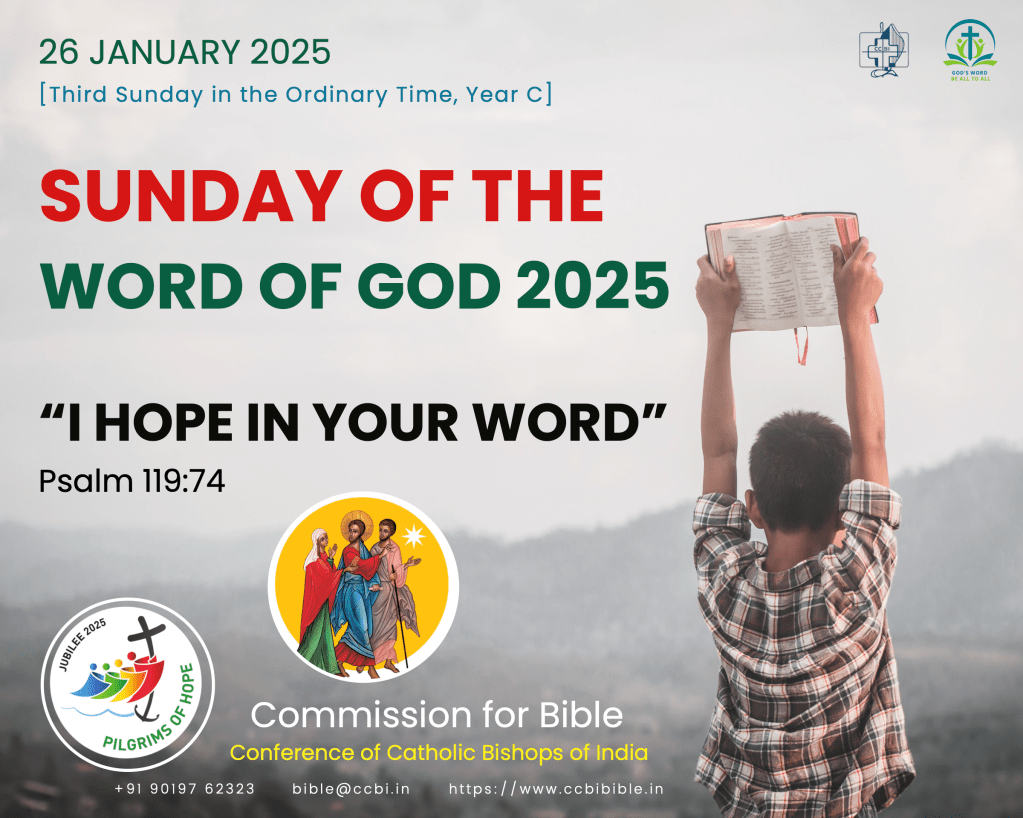
Sunday of the Word of God
Nehemiah 8:2-4a, 5-6, 8-10; Psalm 19; 1 Corinthians 12:12-30; Luke 1:1-4, 4:14-21
Your Word is our Hope!
Pope Francis, in 2019, proclaimed the 3rd Sunday in Ordinary Time as the Sunday of the Word of God. Accordingly, today we celebrate the 6th Sunday of the Word of God. In light of the Jubilee 2025 pilgrim celebrations, the Pope has provided the central theme: “I hope in your word” (cf. Ps 119:74).
Although in India, Bible Sunday or Sunday of the Word of God is often celebrated in September or December, today, we join the universal Church in celebrating this special Sunday.
Let us reflect on today’s scripture passages through the theme: “Your Word is our Hope.”
Hope is primarily a theological Virtue Hope is the desire and expectation of fulfilment. True hope embodies waiting, patience, and peace.
The first reading (cf. Neh 8:2-4a, 5-6, 8-10) is taken from the Book of Nehemiah. Around 450 B.C., during Nehemiah’s tenure as governor, he rebuilt the city of Jerusalem and its temple, which had fallen into ruins. Alongside Ezra, a scribe and priest, Nehemiah led a revival, lifting Judah from confusion, irreligion, and poverty. Together, they reunited a divided people and set them on the path of spiritual and social renewal.
Ezra’s revival began as a public event where all people gathered in an open space before the Water Gate. He read the Law aloud to men, women, and children with understanding. The writer records that “all the people came together as one,” emphasizing unity despite past divisions. Notably, in the inclusive assembly, women and children—typically excluded from the Temple—were invited to hear the Word of God. This signifies equality before God’s Word.
Ezra’s reading of the Law instilled hope in people who thought their lives ended in Babylonian captivity. Witnessing their tears, Ezra comforted them: “Do not weep. This day is holy to the Lord. Go, eat rich foods, drink sweet drinks, and share with those who have nothing prepared. Do not be sad, for the joy of the Lord is your strength.”
Ezra’s instructions carry profound messages: “Do not weep” (repeated four times) urges rejoicing. Sharing with the needy reflects compassion. God’s joy, symbolized in the Law, becomes the people’s strength. Through the reading of the Law, the Israelites realized that God’s Word is their hope.
In the second reading (cf. 1 Cor 12:12-30), Paul addresses divisions within the Church of Corinth, where members competed over spiritual gifts and positions of honour. Using the metaphor of the human body, Paul illustrates the necessity of unity and diversity. He emphasizes that all believers, baptized into one Spirit, form one body in Christ.
Paul reminds them that, despite their unique roles, every member is essential for the body’s functioning. This teaching highlights the error of prioritizing individual prominence over collective unity. Paul transforms their “I” and “mine” mindset into a “we” and “ours” understanding, emphasizing community over self-centeredness.
The Gospel reading (cf. Luke 1:1-4, 4:14-21) comprises two parts: Luke’s prologue (1:1-4) and the beginning of Jesus’ ministry (4:14-21).
Luke declares that his Gospel came as a result of careful research, aimed at leading Theophilus from ignorance to certainty in Christ.
In the second part, Jesus begins His ministry by reading from Isaiah in the synagogue of Nazareth. The passage, drawn from Isaiah 61:1-2 and 58:6, proclaims a message of hope and liberation:
“The Spirit of the Lord is upon me… He has anointed me to bring good news to the poor, proclaim release to the captives, recovery of sight to the blind, and freedom to the oppressed, to announce a year of the Lord’s favour.”
Jesus stops before the phrase, “…the day of vengeance of our God,” emphasizing mercy over retribution. The core message is hope, symbolized by “recovery of sight to the blind.” This blindness refers not just to physical sight but to spiritual insight—recognizing Jesus as the Messiah.
Jesus concludes: “Today this scripture is fulfilled in your hearing.” The people of Nazareth realize that their long-held hopes find fulfilment in Him.
Ezra’s reading of the Law gave hope to the united people of Jerusalem. Similarly, Jesus’ proclamation in Nazareth instilled hope in those gathered in the synagogue.
For the people of Jerusalem, it marked the end of past bitterness. For the people of Nazareth, it signified the beginning of new life.
Let us dedicate time to reading, learning, and sharing God’s Word. As the Psalmist prays: “May the words of my mouth be pleasing to You, O Lord” (cf. Ps 19), let us align our lives with His Word.
Fr. Yesu Karunanidhi
Archdiocese of Madurai
Missionary of Mercy
 Yesu Karunanidhi
Leave a comment