Wed, 1 January ‘25
New Year Day
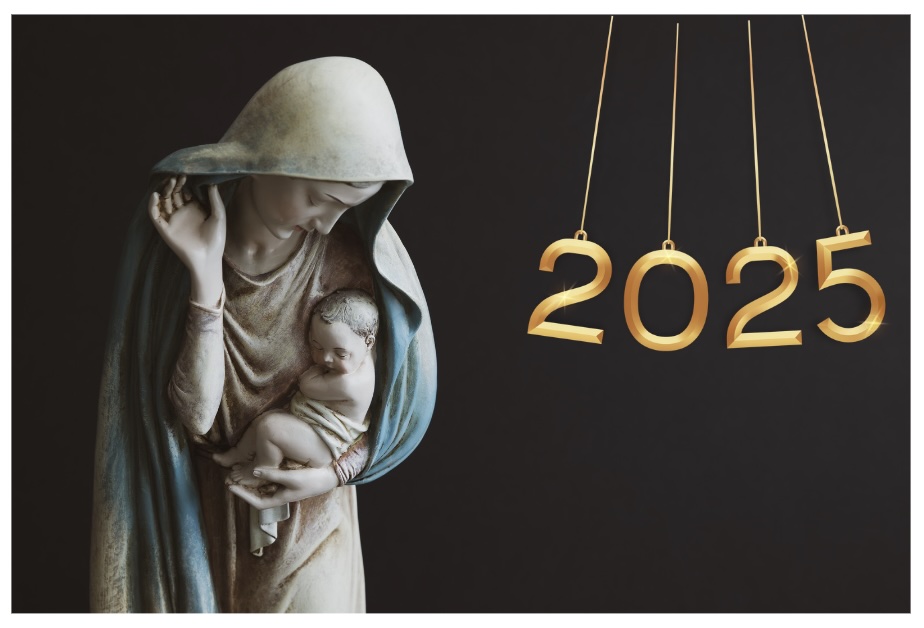
Blessed Virgin Mary Mother of God
Numbers 6:22-27. Galatians 4:4-7. Luke 2:16-21
You are a son, a daughter of God!
Today is significant for three reasons:
1. New Year’s Day in the Gregorian Calendar:
Today, the Earth completes its journey around the Sun and begins a new cycle. As the Earth revolves, so too are we invited to revolve around God. We enter the year 2025. This year, the Mother Church calls us to celebrate the Ordinary Jubilee, which follows the order of ‘25’. This is the first Jubilee of the third millennium, and the theme for the celebration as suggested by our Holy Father Pope Francis is ‘Pilgrims of Hope.’ Numerically, the sum of 2025 is 9, a number associated with Mars. If we make the Angel number out of it – ’20, 02, 25’ the sum is ‘11’ (2,2,7). Thus, the number 2025 is unique because it is both divisible (9, divided by 3) and indivisible (undivided 11). Mathematically, 2025 is a square number (2025= 45 × 45). The previous square number was 1936 (44 x 44), and the next will be 2116 (46 x 46). This rarity of 2025 symbolizes the hope for extraordinary and significant blessings.
Ecclesiastes reminds us, “The end of a matter is better than its beginning” (Eccl. 7:8). For him December is more important than January. Therefore, let us start our January with December in mind. Let us begin with the end in mind.
2. Solemnity of Mary, the Mother of God
Today, we honour Mary as the Mother of God. When Elizabeth greeted Mary, she implicitly proclaimed her as the Mother of God, saying, “And why has this happened to me, that the mother of my Lord comes to me?” (Lk 1:43). The Council of Ephesus (431 AD) affirmed this title against Nestorius’s erroneous Christology. It declared that Emmanuel is God and thus Mary is the Mother of God. While this title was bestowed on Mary, it primarily points to a deeper understanding of Christ. The title is more Christological than Mariological. Mary, who called herself the “slave of the Lord” becomes the “Mother of God.”
3. The Eighth Day (Octave) of Christ’s Birth
On this day, according to Jewish tradition, Jesus was circumcised and named “Jesus” (Joshua – “He saves” or “He redeems”). The timeless God enters time, and the infinite One takes a name.
Let us take for our reflection the following theme: “From being slaves to being sons and daughters: the new identify in Christ.”
In today’s second reading Paul writes to the Galatians: ““God redeemed us who were under the law, so that we might receive adoption as sons and daughters … no longer a slave, but a son and a daughter.”
The Gospel passage, the parable of the lost son in Luke 15:11-32, helps us understand the distinction between a slave and a son. The parable of the lost Son reveals that both the younger and elder sons, though sons, had a servant or slave mentality. The younger son wanted to say to the father, “I am no longer worthy to be called your son; make me like one of your hired servants.” The elder son complained, “All these years I have been slaving for you.” Both failed to recognize their identity as sons. The father, however, restores their identity and grants hem an inheritance: the finest robe, and the assurance, “Everything I have is yours.”
This parable not only illustrates the father’s mercy but also reveals the privileges of sonship.
Am I living as a slave or as a son/daughter with rights and dignity? – let us ask this reflective question.
When Jesus said, “The truth will set you free” (John 8:32), His contemporaries claimed, “We are descendants of Abraham and have never been slaves to anyone.” Jesus replied, “Everyone who sins is a slave to sin. A slave has no permanent place in the family, but a son belongs forever” (John 8:34-35).
Christ liberates us from slavery and raises us to the dignity of children of God.
1. Understanding Our Slavery Today
Paul speaks of being redeemed from slavery under the law. While we may not live under the Mosaic Law, many of us experience forms of slavery in our modern lives:
(a) Slavery to Sin: Habitual sin can trap us, making us feel unworthy of God’s love and unable to break free.
(b) Slavery to Fear: The uncertainties of the world—economic instability, conflicts, or personal struggles—can lead to anxiety and hopelessness.
(c) Slavery to Materialism: In a consumer-driven society, the pursuit of wealth and possessions often takes precedence over spiritual growth.
(d) Slavery to Social Approval: Many struggle with the need for validation from others, losing sight of their identity as beloved children of God.
These challenges bind us, much like the Israelites in Egypt, preventing us from living fully as God’s redeemed children.
St. Paul reminds the Galatians to hold fast to their freedom in Christ:
“It is for freedom that Christ has set us free. Stand firm, then, and do not let yourselves be burdened again by a yoke of slavery” (Gal. 5:1).
2. The Gift of Adoption
Paul tells us that, in the fullness of time, God sent His Son to redeem us. This redemption means more than freedom from sin; it offers us a new identity:
(a) Adoption as Children of God: Through Christ, we are no longer slaves but heirs to the kingdom of God, with the privilege of calling Him “Abba, Father.” In the first reading, God comes down to the level of father and grants the people of Israel his blessings.
(b) Intimacy with God: Adoption signifies a relationship of closeness and love, where we are known and cherished.
(c) Heirs of His Promises: As heirs, we inherit the blessings of peace, protection, and eternal life.
The name “Jesus,” given at His circumcision, reminds us that “God saves”—He saves us not only from our sins but also from the chains that hold us back from living as His children.
Today, on the Solemnity of Mary, Mother of God, we honor her as the one who brought Jesus into the world. Her “yes” to God’s plan allowed the fullness of time to unfold. Mary is a model for us:
A Model of Trust: She trusted God even when His plan was beyond her understanding.
A Model of Obedience: She surrendered her life fully to His will.
A Model of Reflection: She pondered all things in her heart, treasuring God’s work.
Living as Children of God Today:
1. Freedom from Sin: Recognize choices that lead to sin and turn away from them. We can’t be both with God and sin at the same time. If we want to see the Messiah we must let go of the sheep, as did the shepherds in the gospel reading. What is that which I need to give up?
2. Embrace God’s Promises: Rejoice in His blessings of peace, protection, and grace. When God’s face shines on us we become radiant.
3. Discover and Live Your Purpose: Like the shepherds, who left their sheep to witness Christ, seek and act upon your divine calling. The shepherds who received the good news joy become its proclaimers.
4. Find Strength in Jesus’ Name: In moments of weakness or fear, call upon Jesus, the name that saves.
Finally, let us bless one another with God’s blessings: “May the Lord bless you and keep you!”
May the God who makes everything beautiful in its time (Eccl. 3:11) crown this year with His goodness! (Ps. 65:11).
May all our worries disappear as our New Year promises.
Wishes for a blessed New Year filled with peace, joy, and success!
Fr. Yesu Karunanidhi
Archdiocese of Madurai
Missionary of Mercy


 Yesu Karunanidhi
Leave a comment