Daily Catholic Lectio
Friday, 27 December ‘24
Saint John, Apostle and Evangelist
1 John 1:1-4. John 20:2-8
The Other Disciple
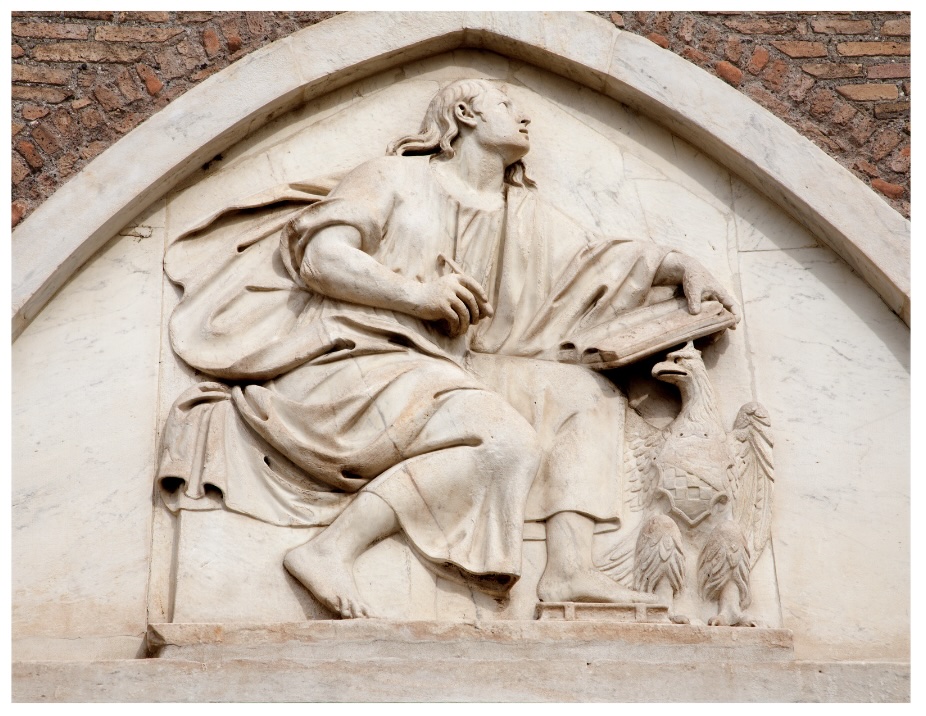
Today we are celebrating the feast of Saint John, Apostle and Evangelist, whom the Fourth Gospel calls ‘The Beloved Disciple’ or ‘The Other Disciple.’ The Synoptic Gospels introduce him as the son of Zebedee and the brother of James. His literature – Gospel of John, three epistles, and the Book of Revelation or Apocalypse—covers almost one-third of the New Testament. He was one of the three apostles who were very close to Jesus, the other two being Peter and James. He was the youngest of all the apostles, and to his care, our Lord handed over the Blessed Virgin Mary. His gospel is given the symbol of an eagle, for the Evangelist possessed the heart of an eagle, rising high and having a wider perspective.
In the first reading, John says that he is recording what he has heard from Jesus and seen in him. Besides, he says that his writings give him joy. In the gospel reading, he presents his testimony to the resurrection of Jesus: ‘he went, he saw, and he believed.’
John and his writings give us seven life lessons:
(1) ‘Living like a good shepherd’
We could live our lives at two levels: ‘like a shepherd’ or ‘like a hired hand’ (cf. Jn 10). Living like a shepherd means owning responsibility for our actions, taking control of our life situation, and having an abundance mindset; living like a hired hand means passing responsibility on to other people, playing a victim game, and having a scarcity mindset. A shepherd is generous, while a hired hand is calculative. The shepherd’s generosity is total, while that of the hired hand is partial.
(2) Discipleship affects our entire lives
Discipleship could be understood with two metaphors: train and aeroplane. People who consider life a train will treat discipleship as one compartment, but for those who treat life as an aeroplane, discipleship entails every aspect of life. A disciple of Jesus is always a disciple; there is no single time or space where s/he can withdraw it.
(3) Jesus is beyond our knowing
At the end of the gospel, John confesses that if he were to write all that Jesus has taught and done, the entire world cannot hold. Experiencing Jesus can’t be expressed fully in words. Jesus stands beyond our knowledge. God is an experience.
(4) The power of witnessing
The characters in the Gospel of John are portrayed as witnesses or testimonies: John the Baptist testifies, ‘Behold, the lamb of God,’ Andrew testifies, ‘we have seen the Messiah,’ the Samaritan woman testifies, ‘come and see,’ the blind man testifies, ‘I was blind; now I see,’ Mary Magdalene testifies, ‘I have seen the Lord.’ Everyone who has experienced Jesus must bear a testimony before others through words and deeds.
(5) The power of dying
Glory and death go hand in hand in the Fourth Gospel. Every act of the gospel has the shadow of Jesus’ death. The ultimate word picture is the grain of wheat: “Unless a grain of wheat falls into the earth and dies, it remains alone; but if it dies, it bears much fruit.”
(6) The power of abiding or staying
In the beginning of the gospel, we have the narrative of the first disciples staying with Jesus. Through the metaphor of the vine and the branches abiding is underscored. Seeing is temporary, while abiding is permanent. Abiding or staying creates deeper connections, but at times we consider abiding a time-waster.
(7) Freedom
‘You will know the truth, and the truth will set you free,’ says Jesus (cf. Jn 8:31–32). Freedom is the ultimate gift that human persons possess. We must always strive for what makes us free internally. Any internal and external factor that hinders freedom must be removed.
May Saint John, who inspires us with these life lessons, intercede for us. Let us resolve to spend a few moments with the writing of John today.
Fr. Yesu Karunanidhi
Archdiocese of Madurai
Missionary of Mercy
 Yesu Karunanidhi
Leave a comment