Daily Catholic Lectio
Wed, 25 December 2024
Nativity of the Lord – Midnight Mass
Isaiah 9:2-4, 6-7; Titus 2:11-14; Luke 2:1-14
We are pilgrims of hope!
Festivals and journeys often go hand in hand. Yet, journeys frequently bring us more anxiety and fear than joy, as we grapple with crowds, rising expenses, long distances, hunger, and financial pressures. Despite these challenges, the celebrations at the end of the journey fill our hearts with happiness and fulfilment. This is especially true as we journey far and wide to celebrate Christmas—the Nativity of the Lord. Liturgically, our hearts and minds have also travelled through the sacred season of Advent, preparing the way for the Lord.
This year’s Christmas holds a uniquely sacred significance. It marks 2025 years since the birth of Jesus Christ, our Redeemer—a Jubilee celebration of grace and salvation! Pope Francis invites us to reflect deeply on the theme, “Pilgrims of Hopeful Journey,” as we celebrate this wondrous mystery of God becoming man.
In today’s Gospel (Luke 2:1-14), proclaimed during the Midnight Mass, two profound journeys inspire our meditation:
1. The Journey of Joseph and Mary to Bethlehem
This journey, initiated by an imperial decree from Caesar Augustus, may appear to be a mere historical event. Yet, from a theological perspective, it is a journey fulfilling the divine plan of salvation. The prophecy of Micah 5:2—“Bethlehem of Ephrathah, though small among the clans of Judah, out of you will come one who will rule over Israel”—is gloriously fulfilled as the Holy Family moves from Nazareth to Bethlehem.
Though outwardly it seems like obedience to human orders, this journey manifests God’s eternal plan of love and redemption. The Creator, transcending time and space, humbles Himself to become a part of human history. During a census when names were being recorded, God Himself chose to enter the narrative of humanity, revealing His holy name to us.
Joseph and Mary faced the challenge of rejection—there was no room at the inn. Yet, God did not abandon His plan. He chose a humble manger as His dwelling place, transforming it into the throne of divine grace.
2. The Angels’ Journey to the Shepherds
While the first journey was planned, the second was a sudden and divine intervention. Heaven touched earth as God’s messenger appeared to announce the “good news of great joy” to the shepherds, the simple, the poor, and the marginalized. The angel did not bring a command but shared the joyous proclamation of the Savior’s birth, giving them a sign: “You will find a baby wrapped in cloths and lying in a manger.”
These two journeys mirror our own lives. Some journeys are meticulously planned; others come unexpectedly. Some are guided by human will; others align with God’s divine purpose. Regardless of their nature, every journey invites us to move forward in faith and hope, trusting in God’s providence.
In the sacred event of Christ’s birth, God places His footsteps among us. This teaches us three profound lessons:
(a) Break Barriers
The Nativity reveals the heart of the Gospel: the Almighty God embraced human limitations. The infinite Creator became a helpless child, and the King of kings was born in poverty, dwelling in a manger.
Joseph and Mary, too, broke barriers. Faced with rejection at the inn, they persisted in seeking a place for the Savior’s birth. This invites us to rise above our own self-imposed limitations—fear, prejudice, hesitation, and complacency—and embrace our identity as children of God.
Breaking barriers requires action. When Joseph found no room, he sought and made a place for Christ. Similarly, we are called to act decisively to overcome the obstacles in our lives.
St. Paul reminds us: “The grace of God has appeared, offering salvation to all” (Titus 2:11). God’s grace empowers us to grow and be transformed. As the Prophet Isaiah proclaims: “The yoke that burdens the people has been removed” (Isaiah 9:4). What yoke do we carry today that Christ invites us to lay down?
(b) You Are the Light!
The symbol of light shines prominently in the Nativity. The angelic announcement to the shepherds was surrounded by “the glory of the Lord” (Luke 2:9). Isaiah speaks of the people seeing a “great light” (Isaiah 9:2). The Magi followed the light of a star. Simeon, in the temple, hailed Jesus as “a light for revelation to the Gentiles” (Luke 2:32).
Light signifies life and divine presence. As John declares: “In Him was life, and that life was the light of all people” (John 1:4). Jesus, in the Sermon on the Mount, calls us to be that light: “You are the light of the world” (Matthew 5:14). To walk in Christ’s light is to live truthfully and to illuminate the lives of others.
Let us step out of darkness and embrace the armor of light, as Paul exhorts: “The night is far gone; the day is near” (Romans 13:12). May our lives reflect Christ’s light, bringing His love and truth to our families, communities, and the world.
(c) Live Communion
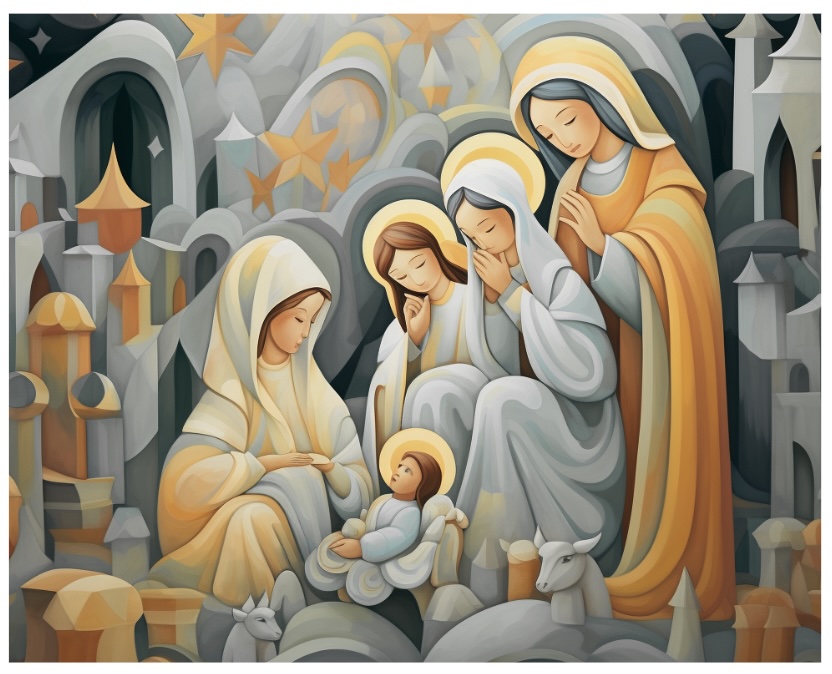
The Nativity scene is a beautiful image of harmony. It unites angels and shepherds, kings and the poor, heavenly and earthly beings. Christ’s birth breaks down the walls of division, as Paul proclaims: “He is our peace, who has made the two groups one and has destroyed the dividing wall of hostility” (Ephesians 2:14).
Pope Francis emphasizes fraternity and unity as the essence of synodality. True communion calls us to overcome divisions based on gender, religion, caste, language, or wealth. As pilgrims of hope, we journey together toward a Jubilee of grace, shedding all that divides us and embracing one another in love.
Joseph and Mary journeyed as pilgrims of hope. Angels descended to proclaim the fulfilment of hope. We, too, are pilgrims of hope, called to rise and continue the journey.
“May the God of hope fill you with all joy and peace as you trust in Him, so that you may overflow with hope by the power of the Holy Spirit” (Romans 15:13).
Fr. Yesu Karunanidhi
Archdiocese of Madurai
Missionary of Mercy
 Yesu Karunanidhi
Leave a comment