Daily Catholic Lectio
Friday, 20 Dec ‘24
Advent Weekdays
Isaiah 7:10-14. Luke 1:26-38
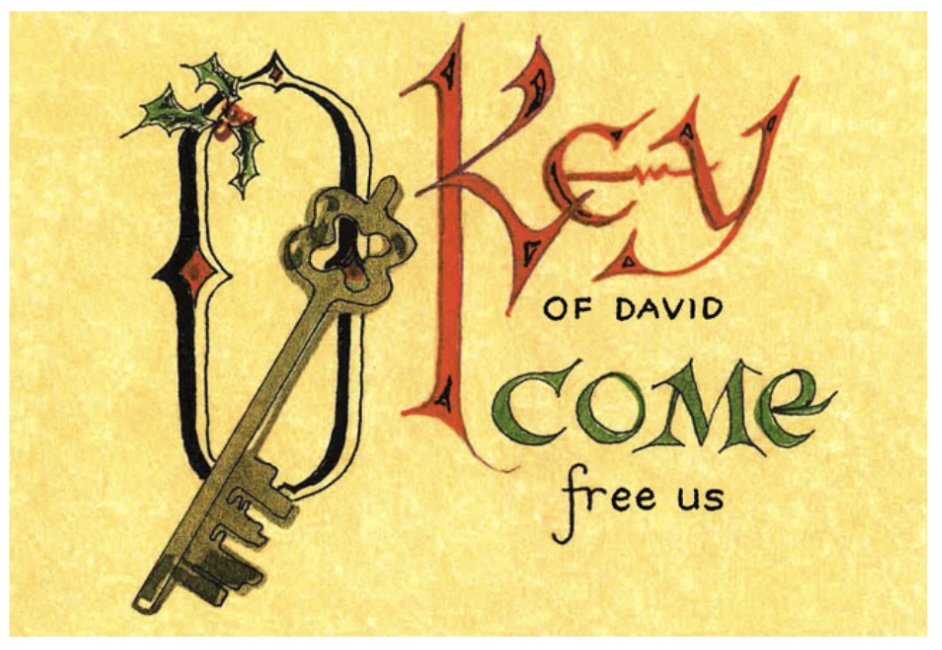
O Key of David, come!
The fourth ‘O Antiphon’ that we reflect on today is ‘O Key of David, come!’. This antiphon is set in the background of the following Biblical texts: “And I will place on his shoulder the key of the house of David. He shall open, and none shall shut; and he shall shut, and none shall open” (Isa 22:22); “the words of the holy one, the true one, who has the key of David, who opens and no one will shut, who shuts and no one opens” (Rev 3:7).
Being in possession of the key signifies ownership and authority. Jesus, who holds the keys to heaven, lets everyone in (cf. Lk 23:43). Key also refers to the instrument that sheds light on a riddle or a problem.
The expression ‘key of David’ points to three keys: (a) The key to the city. A king has authority over the entire city. (b) The key to the treasury. The king possesses access to the resources of his kingdom. (c) The key to the temple. In the Messianic reading, a door in the Temple of Jerusalem was always kept closed. It was believed that when the Messiah came, he would open that door. What he opens, nobody can close, and what he closes, nobody can open.
The readings of the day bring before us two individuals who, through the intervention of God, are led to clarity, vision, confidence, and action. God opens the doors for them.
In the first reading, Prophet Isaiah gives the sign of ‘Immanuel’ to King Ahaz. After the death of King Solomon, the United Kingdom of Israel was divided into the Northern Kingdom and the Southern Kingdom. The Northern Kingdom was called Israel, and it had Samaria as its capital, while the Southern Kingdom was called Judah, with Jerusalem as its capital. Ahaz ruled Judah from 735 to 720 BC. King Pekah of Israel wanted to fight against Ahaz so that he would take Ahaz to join him in fighting Assyria. Ahaz, to escape the siege, must join hands either with Assyria or Egypt. To the terrified and confused king, God sends Prophet Isaiah with a sign: ‘Behold, the virgin shall conceive and bear a son, and shall call his name Immanuel.’ The ‘virgin’ here refers to a wife of Ahaz or someone from his harem. The son referred to here is Hezekiah. In the Christian reading, the virgin is Mary of Nazareth, and the son is Jesus. Ahaz is asked to cling on to God alone.
The gospel reading brings to us the narrative of the annunciation. The angel Gabriel, who visits Mary, tells her, ‘You will conceive in your womb and bear a son.’ Mary asks, ‘How will this be since I am a virgin?’ The angel answers her, ‘Elizabeth, in her old age, has also conceived a son… nothing will be impossible with God.’ Upon hearing the angel, Mary replies, ‘I am the handmaid of the Lord; let it be done to me according to your word.’
Let us consider the words of Mary. Mary does not reply, “I shall do it.” But she replies, “Let it be done to me.” This is a great lesson for us. Often in life, we want to do things by ourselves; we continue to do many things. We are preoccupied with doing things. But God invites us to allow him to do things for us. He knows the world better than we do. He knows life better than us.
When the Lord led the people of Israel from Egypt to the Promised Land, when they were afraid of the Red Sea in the front and the Pharaoh at the back, the Lord told them, ‘Be still.’ The Lord knew that if they attempted to fight, they would make a mess, for they were used to making bricks, not fighting wars.
When we are beset with fear, confusion, anxiety, and hesitation, it is good that we remain patient and still. We need to be like locks, patiently waiting for the owner to come with the key. Like Ahaz and Mary, let us allow God to act in our lives. ‘Let it be done according to him!’
Let the Key of David come and open our lives.
Let our prayer today be:
‘O Key of David (Isa 22:22; Rev 3:7), and Sceptre of the house of Israel (Num 24:17), you open and no one closes; you close and no one opens (Isa 22:22). Come, and deliver him from the chains of prison who sits in darkness and in the shadow of death (Ps 107:10).’
Fr. Yesu Karunanidhi
Archdiocese of Madurai
Missionary of Mercy

 Yesu Karunanidhi
Leave a comment