Daily Catholic Lectio
Sunday, 3 November 2024
XXXI Sunday in Ordinary Time
Deuteronomy 6:2-6. Hebrews 7:23-28. Mark 12:28-34
Essentials of Life
The question that has been following us from the day humanity took its first step until today is, ‘What is the essence of life?’ or ‘What is the essential that applies to everything, everywhere, and at all times?’ Metaphysics, theology, science – all fields are seeking the answer to this question. Such a question was asked in the time of the Old Testament and in the time of Jesus. The answers given by Moses and Jesus, and the calls they make, are what we are about to hear in today’s scriptural worship.
The first reading is considered the fundamental creed of the Jewish faith. This section, called the ‘Great Shema’ or ‘Great Hearing’, begins with the verb ‘Hear’ (‘Listen’). In our reading passage, this word appears in the imperative form. The people of Israel are in the final stage of their desert journey. Moses is conversing with them in the plains of Moab, before they enter the promised land flowing with milk and honey. He is recalling the important events of their lives. He instructs them on how their way of life should be in the new land. Realizing that it is impossible for them to remember his teachings, Moses conveys the two fundamental elements of their faith and life through the two imperative verbs ‘Listen’.
First, ‘Listen to the commandments.’ The commandments include the Ten Commandments given by God the Lord through Moses on Mount Sinai, as well as the various norms and regulations that Moses gave to the people in different contexts. Moses proposes that the reward for observing the commandments is long life.
Secondly, Moses says ‘Listen, the Lord our God is one Lord.’ Here, ‘the Lord’ refers to the name of the divine. Moses clearly states that this God is the God of Israel, and it is on this creed that the religion of Israel is built. The people of Israel must ‘love the Lord your God with all your heart, with all your soul, and with all your might.’ For the people of Israel, ‘heart’ was considered the seat of thinking, ‘soul’ the seat of life, and ‘might’ the seat of vital energy. So, the command of Moses through ‘Listen’ clearly indicates that God must dwell in one’s entire being – body, mind, and spirit. The sufferings experienced by Israel in later times were due to their forgetting these commandments.
So, the lesson of the first reading is that the primary thing one must hold in all circumstances of life is to love the Lord God.
In the second reading, the author of the Letter to the Hebrews continues the theme of the unique high priesthood of Jesus. The priesthood or ministry of Jesus is enduring and permanent. The other high priests are human, so their priesthood ends with their lives. But Jesus, as God and as the one who has died and risen, is permanent. Therefore, his grace is also eternal. His priesthood is established in the promise given by God, ‘You are a priest forever.’ The primacy of Jesus’ priesthood lies in its being grounded in God’s promise.
In the Gospel reading, the biblical scholar who comes to meet Jesus is in a state of confusion. He has not come to test Jesus. Rather, he is seeking an answer or clarity for his confusion. In the time of Jesus, there were 613 commandments, norms and regulations in the Jewish law.
For example, the fourth commandment was to ‘observe the Sabbath’ (‘to rest from work’). But, the schools of Jesus’ time had interpreted that on the Sabbath day a woman must not look at a mirror. For when she looks at the mirror and finds a grey hair on her and moves it to pluck it off, she would violate the Sabbath Law.
Each rabbi or each school taught the primacy of different ones among these. Moreover, those belonging to one school would argue and debate with those of another school.
Jesus presents his answer very simply. Referring to the ‘Shema’ commandment of the Old Testament, he proposes the love of God and, citing Leviticus 19:18, the love of neighbour, and places the two on the same plane. Thus, without creating a hierarchy among the commandments, Jesus presents that the commandments are interrelated, and that the fundamental link among them is love.
So, for Jesus, the word ‘love’ determines the essence of life, and loving God is even more important. From this love flows the love of neighbour.
What are the lessons for us?
The sessions of the Synodal Assembly have come to an end.
This day calls us to set right our priorities at the level of the entire Church, our diocese, and our personal lives. We must first define what our priorities are. Moreover, those priorities must be primary. Efforts must be made to maintain those priorities.
Love of God is the connection we must have. That is, this is the foundation for everything. Many times, we understand love of God only in the limited sense of praying or offering the Eucharist. But we understand love of God as the starting point of our life. Jesus was united with his Father in prayer. Through prayer, he renewed his connection daily. So, the soul, mind, and body of Jesus were nourished by this connection.
Between love of God and love of neighbour is ‘self-love.’ ‘Love your neighbour as yourself,’ says Jesus. Self-love is not selfishness. Rather, it is self-esteem, and self-care. The Bible says that no one ever hates their own body. Naturally, we show love and care for ourselves. In self-love, I know, accept, and respect myself. This is ‘cultivation.’
Love of neighbour is the hand I must extend to the other. It is only when I stand firmly on God’s ground, elevate myself, and reach out my hand to others that I can transform my life into something meaningful. Otherwise, my life will be confined within myself. This is ‘contribution.’
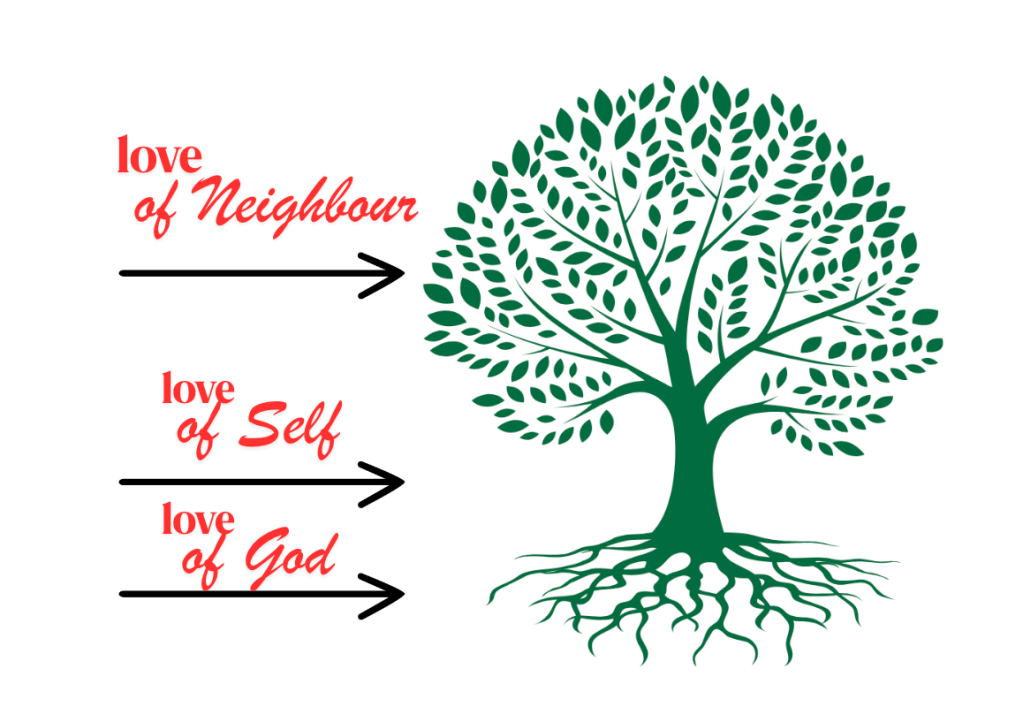
If we compare the above three to a tree, ‘love of God’ would be the root, ‘self-love’ the trunk, and ‘love of neighbour’ the branches.
The author of today’s responsorial psalm declares, ‘I love you, O Lord, my strength’ (Ps 18). The author, having declared his love, moves his life in the shadow of this attachment. He understands that knowing, declaring, and living one’s priorities is the beginning.
Fr. Yesu Karunanidhi
Archdiocese of Madurai
Missionary of Mercy
 Yesu Karunanidhi
Leave a comment