Daily Catholic Lectio
Sun, 28 July 2024
Seventeenth Sunday in Ordinary Time
Fourth World Day for Grandparents and the Elderly
2 Kings 4:42-44. Ephesians 4:1-6. John 6:1-15
You open your hand!
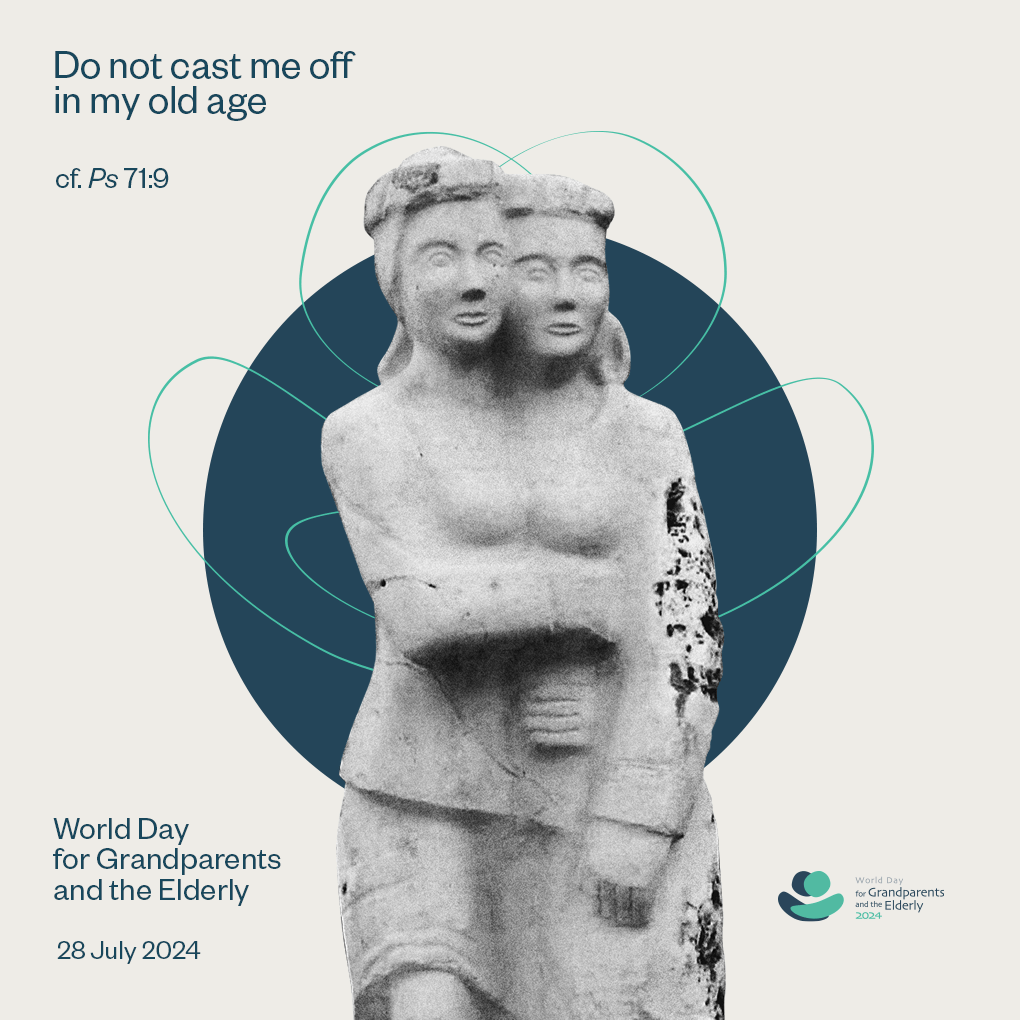
This Sunday is being celebrated as World Day for Grandparents and the Elderly. In 2021, our Holy Father, Pope Francis, established this day as a day to be celebrated along with the commemoration of Saints Joachim and Anne, the parents of the Blessed Virgin Mary, and the grandparents of Jesus. The message for this year is centred on Ps 71:9: “Do not cast me off in my old age!” The day invites us to reflect on the loneliness, emptiness, despair, and weariness of old age.
Let us reflect on the readings of the day in light of our Holy Father’s message for the day for grandparents and the elderly. In today’s responsorial psalm (cf. 145), the psalmist sings: “The eyes of all look hopefully to you, and you give them their food in due season; you open your hand and satisfy the desire of every living thing.”
The ‘opening of hand’ is a symbol of generosity, readiness, and giving.
The gospel reading brings before us the event of the multiplication of loaves. We have been reading from the Gospel of Mark (Year B). For four weeks from today on, we will read from John 6. All four gospels record the event of Jesus feeding the five thousand.
The location of the Sea of Tiberias, and the time when the Passover festival is approaching, indicate the context of the event. The Sea of Galilee was also named the Sea of Tiberias because there was a city built for the Roman Emperor Tiberius near the Sea of Galilee. The Passover festival reminded the Jews of the freedom of the Israelites and the wonderful presence of the Lord God. John mentions the time and place to show that Jesus was an emperor who would give food to his people, and he would liberate the new Israelites.
The miracle begins as a conversation between Philip and Jesus. “Where can we buy enough food for them to eat?” Jesus asks Philip. Jesus asks us to test him. Because, at the Cana event, Jesus turned water into wine. This had a positive impact on the disciples. However, they forgot. Philip figures out an answer: “Two hundred days’ wages worth of food would not be enough for each of them to have a little.” In fact, he forgot that Jesus was a wonder-worker.
Andrew goes a step further. He brings a boy to Jesus, saying, “There is a boy here who has five barley loaves and two fish; but what good are these for so many?” Andrew is worried because of the largeness of crowd – at times, we too are worried looking at the size of the problem!
“Make the people sit down,” Jesus commands. “There was a great deal of grass.” John makes a point. Those who have been looking at the sea, the shore, and the mountains suddenly begin to see the grass in front of them. This is the beginning of a miracle.
Jesus “takes the loaves, gives thanks, and gives them to the people.” The words used here are the same as those used in the Institution of the Eucharist.
“They were filled. And there was more!” Both the stomachs and the baskets were full.
The miracle happens in three stages:
(a) Philip mode: ‘we can’t’; ‘it’s not possible.’
(b) Andrew mode: ‘we may make it, but not everything!’
(c) Jesus mode: ‘everything is possible.’
That is, not by the opening of our hands, but by the opening of God’s hands – by taking, giving thanks, and giving to people – the miracle takes place!
In today’s first reading, too, the ‘multiplication of loaves’ takes place. Elisha, called the prophet of miracles, takes twenty loaves of bread and feeds a hundred people. Elisha opens his hands and gives away the loaves that were brought to him.
It is against this background that the people acclaim at the end of the event in the gospel reading: “This is truly the Prophet, the one who is to come into the world.” They try to make Jesus their king. Ironically, it is not Tiberias, the Emperor, who feeds the people, but Jesus, the Lord. Saint Augustine, reflecting on this text, says, “What a pity for humankind! Instead of seeking in Jesus the God who feeds their souls, the people saw a King who would feed his stomachs!”
In the second reading, Saint Paul, whose hands are ‘tied’ invites the people to open their hands and to reach out to each other in unity. Writing about the working of God, he says, “God is above all, through all, and in all.” These words tell us the nearness (immanence) of God. The Lord works through us and in us.
What are the three-basket ‘takeaways’?
(a) From the hands of the Lord!
When a small child picks up candy with his hands, he gets a few in his hands. But if the shopkeeper gives, his hands are full. When we think that our denarius or our effort is enough, we get less. But when we surrender to God, he makes our hands and baskets full. Let us have strong faith that God will fill our hands.
(b) Open your hands!
As we receive from God’s hands, let us open our hands a little. The Lord instructs the people of Israel not to close their hands to the needy (cf. Deut 15:7). Even if our hands are empty, we will at least try to lift the other person by stretching out our bare hands.
(c) The hands of the elderly!
Jesus says to Peter, “When you grow old, you will stretch out your hands’ (cf. John 21:18). Our grandparents and elders stretch out their hands. Let us not abandon them when they are in their helplessness and have given themselves to us all their lives. We shall stand with them in their loneliness, in their fatigue, in sickness, and in their distress. Let those who cannot bear their helplessness have faith that all is possible because our hands are with them!
“The hand of the Lord feeds us; he answers all our needs.” (cf. Ps 145)
Fr. Yesu Karunanidhi
Archdiocese of Madurai
Missionary of Mercy
 Yesu Karunanidhi
Leave a comment