Daily Catholic Lectio
Sun, 23 June 2024
Twelfth Sunday in Ordinary Time – Year B
Job 38:1, 8-11. 2 Corinthians 5:14-17. Mark 4:35-41
Storm and calm!
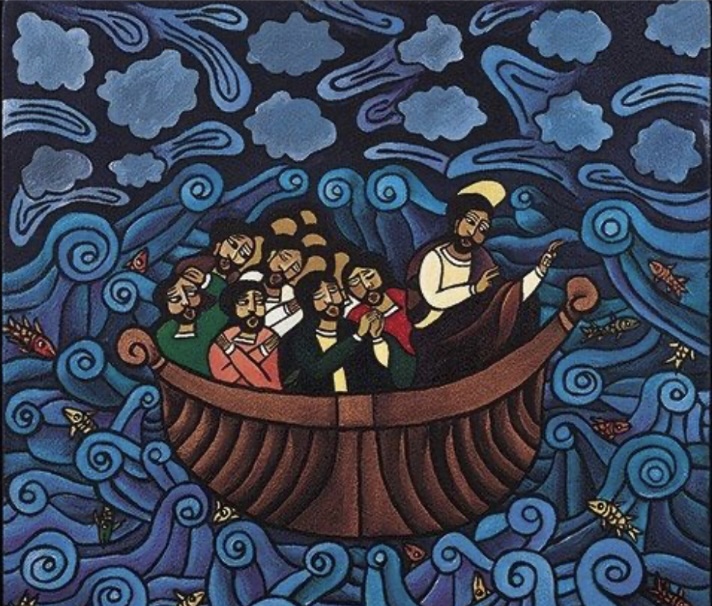
That evening Albert went to sea alone. He saw some boats standing far away from his boat. He went a little farther, knowing that there were people in the distance. After a while it began to get dark. The boats in the distance disappeared from his sight. The shore too was out of reach. Suddenly the wind began to blow and the waves rose up. The rain fell as well. Fear gripped him. A few hours ago he had fought with his parents at home and came into the sea. He rebuked his own anger. He wanted to return home somehow. He remembered the story that his grandmother had told him when he was young. When the grandmother told the story of Jesus calming the storm on the Sea of Galilee, she said: “If the Lord were in our boat, the storms would calm.” Albert closed his eyes and prayed for a minute. He mumbled, “Lord! Come into my boat!” Minutes after he opened his eyes, he saw the light house in the distance. Being excited to know the direction, he crossed towards the shore. The waves began to slow down. The waves of anger in his heart ceased as well.
#
In today’s Gospel passage we read about Jesus calming the storm. When we look at the Gospel passage in the context of Mark’s Gospel, the section of parables ends and here begins the section of miracles (signs or wonders). In terms of miracle, the text belongs to the category of ‘nature miracle’ (the other types are exorcism, and healing miracle). This mighty act indicates that Jesus had power over nature. Moreover, this passage can also be taken as a parable. In this case, Jesus sleeps with a pillow. ‘Sleep’ refers to ‘death’ or ‘absence’. After Jesus’ death or ascension, Mark’s group faces many problems. Their boat ride was not pleasant. They felt the absence of God. Through this incident, Mark gives encouragement to his community. That is, Jesus still cares for us even when he has left us (and has fallen asleep). We can face any adversity in His presence (and absence).
At the beginning of the Gospel passage, Jesus says: “Let us go across to the other side.” With care he leads them to the other side. When we become frozen by life’s events, Jesus invites us to “go across to the other side.” We must get up often and go to the other side.
At that time the storm is raging. The Sea of Galilee, also known as the Lake of Gennesaret, is actually a lake. Due to its presence of mountains and below sea level, waves of about 20 feet high are experienced during high winds. Most of Jesus’ disciples were fishermen or lived around the sea. So, they often faced the waves. In this instance, Mark says that there was a great storm and brings before us two situations: one, the peaceful situation. In that situation, Jesus is sleeping with a pillow in the boat. The second is the opposite, fear situation. The disciples are terrified and frightened. “Teacher, do you not care that we are perishing?” They see Jesus as just a teacher (Rabbi). They try to force him to their situation. They frighten Jesus.
Jesus gets up and rebukes the sea. ‘Peace, be still!” is the formula for exorcism rebuke. Jesus calms the sea with the same words. Because, for the Jewish people, the sea was considered a place of demons. Jesus continues to rebuke his disciples: ‘Why are you afraid? Do you still not believe?’ Jesus rebukes them for their lack of faith. That is, they refused to believe that they could not die when Jesus was with them. This is their lack of trust. These questions were not asked just by looking at the disciples. Each of us who reads this text is asked. You and I must answer these two questions individually. The answer to the question, “Who sleeps in a boat and rebukes the wind?” depends on the answer we give.
Here we see the concern of Jesus. First, he makes the storm calm. Then he gives hope to his disciples. First, he removes their painful situation.
In the first reading, we read the first part of God’s response to Job from the whirlwind. The book of Job seeks the answer to the question, ‘Why do the righteous suffer?’ Job’s three friends try to provide the answer to the righteous suffering with traditional theology. Their answer was not acceptable to Job. The Lord who appears in the whirlwind does not answer Job’s question but surrounds him with many questions. He makes Job realize that He is the Lord of all and that He alone is the mystery of life. As a result, Job surrenders. In this passage we see the power of the Lord God over the sea.
Job’s normal life is affected. He has lost everything that belongs to him and sits in the ashes as if he had died, or grieved death. Job sees the presence of God even at that moment when he feels as if the intimacy between him and the universe has been broken. The Lord God Himself defined the waves, ‘Come no more!’ If so, then nature is subject to God.
In the second reading, Paul writes to the Corinthian church about the true nature of his apostolic work and says, “The love of Christ controls us.” It is the love of Christ that overwhelms the disciples who are threatened by the waves in the boat. Thus, “the old passes away and the new comes” – the waves cease and there is peace; storms calm!
What are the life lessons?
(a) The storm and the calm (God) are the realities of our lives. The events of life move in front of us and God is behind us sleeping. Many times, our eyes are on the waves in front of us, not on the God who sleeps behind us. It is enough to turn our hearts a little! He will become the leader of our boat. “Your proud waves be stayed” – God commands the waves and our sufferings.
(b) In their fear, the disciples cry out: ‘Teacher, we are about to die!’ Let our voice be slightly different: ‘Lord, we are going to live! What should we do?’ There is no place for death in God’s presence.
(c) May the great love of Christ envelop us always. No matter what negative experiences we have in our relationships – whether we are misunderstood, isolated, or lonely – we will submit ourselves under His love. He will exalt us.
Let us join the Psalmist in the Responsorial Psalm, “”O give thanks to the Lord for he is good; for his mercy endures forever … He stilled the storm to a whisper, and the waves of the sea were hushed” (cf. Ps 107).
God is with us on our journey across the other side, calming the storm!
Fr. Yesu Karunanidhi
Archdiocese of Madurai
Missionary of Mercy
 Yesu Karunanidhi
Leave a comment