Daily Catholic Lectio
Sun, 2 June 2024
Most Holy Body and Blood of Christ, Solemnity
Exodus 24:3-8. Hebrews 9:11-15. Mark 14:12-16, 22-26
Take it
In a quiet village, an old baker named Samuel was renowned for his bread, which carried a piece of his heart and brought comfort to all. One evening, a weary traveller knocked on Samuel’s door. Samuel welcomed him, offering a warm loaf of bread and a cup of wine.
“Take it,” Samuel said.
The traveller, moved to tears, confessed he had nothing to offer in return. Samuel replied, “This bread is more than food. It symbolises my care and something greater. Take it, and be nourished.”
As the traveller ate, his weariness lifted, and peace enveloped him. Revealing he was a priest seeking to understand the Eucharist, he realised Samuel’s bread was a living metaphor for Christ’s words, “Take it; this is my body.”
Samuel nodded, “The Eucharist is a gift of love, meant to bring us closer to God and each other.”
From then on, the priest remembered the baker’s lesson, understanding that Christ’s love is always present in the Eucharist, inviting us to partake and be transformed.
#
Today we celebrate the Most Holy Body and Blood of Christ. After the celebration of the Solemnity of the Most Holy Trinity, something that is very abstract, intangible, and subtle, our Mother Church invites us to reflect on the Eucharist, which is very concrete, tangible, and satisfying.
Whenever we participate in the Holy Mass, we are ‘in touch’ with the Eucharist. We take it and eat it.
‘Take it’ – this is the simple yet profound invitation of Jesus.
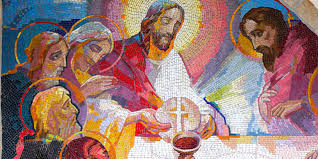
Jesus utters these words during his Last Supper, the celebration of the Passover meal with his apostles in the upper room. Jesus takes the ordinary elements of the meal and gives them an extraordinary meaning. The bread, he offers as his body, and the wine, he offers as the blood of the covenant.
Let us compare the words of Jesus ‘take it’ with the Fall narrative. The Lord God told Adam and Eve, ‘Don’t take it!’ He forbade them from eating the fruit. But they took it and ate it. They trespassed on the Lord’s commandment when they ‘took it.’ As a result, they had to be expelled from the presence of the Lord; they had to be sent out of the garden.
But the words of Jesus, ‘Take it’, offer a free and willing invitation to every one of us. The Eucharist undoes the alienation that our first parents experienced after their disobedience. Christ’s obedience until death restores our relationship with God.
‘Take it’ symbolises accepting Christ’s gift of himself, embodying his love and sacrifice. The Eucharist is primarily a gift that Christ offers to us. We don’t need to offer anything to Christ. He offers himself. It is his desire for us that pulls us towards him, and out of his desire, he gives himself freely to us. Our task is to find the ‘upper room,’ where everything is prepared beforehand. The Eucharist is a perpetual reminder of Christ’s boundless love, calling us to deeper communion with Him and with each other.
Secondly, ‘covenant.’ For the people of Israel, ‘covenant’ was more than a word; it was a relationship initiated by God freely to embrace them as his sons and daughters. He entered a parental relationship with them, giving them protection, sustenance, and growth. In today’s first reading, we see the making and ratification of the covenant. The covenant is made in the hearing of the people. Moses announces to the people of Israel the words that the Lord has spoken. And people hear the words and make a profound response: “All that the LORD has said, we will heed and do.” The covenant is ratified by the blood of the animals, which is poured on the people and on the ark. The same blood that is sprinkled externally reminds the people of the invisible blood that flows between them and the Lord. There is assurance, obedience, and bonding.
At the Holy Mass, we celebrate this covenant. The covenant is made in the first part of the Mass, the liturgy of the Word, where we hear the words of God from the Holy Bible, and the covenant is ratified in the second part, the liturgy of the bread, where we eat (and drink) Christ’s body (and blood). We partake in the same cup. The Eucharist – like Samuel’s bread (anecdote) provides spiritual sustenance, transforming and strengthening us.
This covenant is superior to the previous on two grounds: (a) For, as the Second Reading puts it, the earlier covenant was ratified with the blood of the animals, but the present covenant is ratified by the blood of Christ, the Supreme High Priest. Christ “cleanses our consciences from dead works to worship the living God.” (b) The earlier covenant was made only with the people of Israel, but this covenant of Jesus is made with all – the entire humanity and the universe – “poured out for many (all)” (cf. Mk 14:24).
Thirdly, ‘looking ahead.’ Jesus concludes the Passover meal by saying, “Truly I say to you, I shall not drink again the fruit of the vine until the day when I drink it new in the kingdom of God” (Mk 14:25). Jesus refers to sharing a cup again in the Kingdom of God, hinting at the future and hope. The Eucharist does not end with our consuming the body of Christ at the Mass. It makes us hopeful for the Kingdom, the future of God’s reign. The Eucharist makes us wait with patience for something that is eternal and enriching.
Finally, ‘going to the Mount of Olives.’ Jesus, immediately after the Passover meal, along with his disciples, goes to the Mount of Olives – and from there to Calvary. Jesus, in fact, passes over – from the upper room to the Mount of Olives and Calvary. Jesus is ready to be sacrificed as a Passover lamb, and through his Cross and resurrection, he saves all of humanity. The hyphen between the upper room and the cross is the Mount of Olives, where Jesus experienced his vulnerability, where the cup of suffering was difficult to bear, and where he said a final and firm yes to the will of the Father. The Eucharistic celebration invites us to embrace our vulnerability and that of others and calls us to total surrender.
Challenges and lessons:
Today, often times, the Eucharistic celebration has become a burden, boredom, and routine for both the celebrants and the participants. The reason is that we consider the celebration our task. No, this is not our task. This is Jesus’ gift. Our work is just to receive. We are not givers in the Eucharist; we are mere receivers. We just need an open arm. That’s it. The rest is taken care of by the Lord himself.
At the Eucharist, Jesus tells me, ‘Take it; this is my body.’ This gesture of Jesus must be imitated. I must tell my family and society, ‘Take it, this is me!’ I must be ready for love and self-gift. Be it a blood relationship, a marriage relationship, or a water (tears of humanity) relationship, I must make it a covenant through my ‘giving up.’ Unless I give myself up and away, others cannot take it.
Since the Eucharist gives us hope to see things beyond our eyes, we must be able to enter the Mount of Olives with joy and acceptance. We must impart this hope to others, and we must stop to wipe away the tears of humanity that are poured into the Gethsemane of the world.
Wishes and prayers on this Solemnity of love, self-gift, and hope.
Fr. Yesu Karunanidhi
Archdiocese of Madurai
Missionary of Mercy
# Be M.er.cy.Fool


 Yesu Karunanidhi
Leave a comment