Daily Catholic Lectio
Sun, 12 May 2024
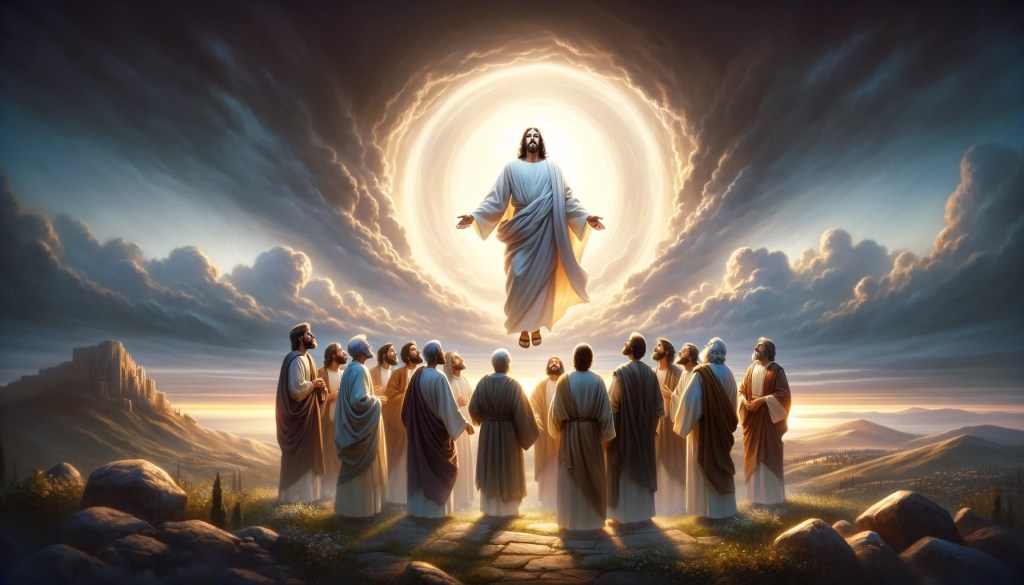
Ascension of the Lord – Solemnity
Acts 1:1-11. Ephesians 4:1-13. Mark 16:15-20
God’s abiding presence
Today, we celebrate the ascension of our Lord. However, there are three elements or factors that hinder our understanding of ascension.
Obstacle 1: Jesus’ body
At incarnation, the Son, the second person of the Most Holy Trinity, became a human person. He was made flesh; he had a body, which made him move to different places. At the resurrection, Jesus possessed a different kind of body, which made him appear to his disciples, pierce through the closed doors and walls, and dine with them. We believe that Jesus ascended to heaven with his body. Now, how do we reconcile the body of Jesus with the rest of the Most Holy Trinity?
Obstacle 2: Space-Time Elements
Jesus, who came to be part of human space and time, now goes out of human space and time. He begins to reign, sitting at the side of the Father, and still continues to be present here. Now, how do we understand his presence with us? Does he live in our hearts because of our faith? Or is he really present here?
Obstacle 3: Those who saw it did not write, and those who wrote it did not see.
The ascension narrative is recorded by Mark and Luke. Matthew, who presents Jesus as ‘God with us’ (Emmanuel), does not want Jesus to leave the world. In Matthew, there is no ascension narrative. John, who was recording even the minute details, leaves out the narrative of ascension. Luke presents ascension in the gospel as happening on the day of the resurrection, but in the Acts as happening after 40 days.
There is a semantic problem as well. Jesus ascended to heaven. Or was Jesus taken into heaven? The Greek word that Luke uses is in the passive voice. Jesus was accepted into heaven, or assumed into heaven.
How do we reconcile ourselves with these questions?
If we change the question, we can change the perspective.
We shall not ask, ‘How was the ascension?’ But let us ask, ‘Why was the ascension?’
The ascension was significant for Jesus in three ways:
(a) Jesus returns to his Father after completing his work here on earth. At ascension, the circle of incarnation comes to a close.
(b) Jesus gives his apostles the work of the kingdom to be continued. The church has to continue the mission of Jesus.
(c) Jesus promises that he will send us the Holy Spirit. As we hear from the first reading, the disciples wait in Jerusalem for the descent of the Holy Spirit. They continue the mission that Jesus commanded.
What are the lessons for us today?
(a) Jesus’ presence. Jesus, who came down as ‘God with us’, now goes up as ‘God for us.’ He does not desert us, but he tells us that through his actions we too will rise to him. As Paul mentions in the second reading, Jesus ascended so that he could fill the entire universe. Jesus continues to be present in his church and the world through different ministries and charisms.
(b) Jesus’ action. In the gospel reading, Mark writes that the Lord was with the disciples and confirmed their words through accompanying actions. Action is the other dimension of presence. God continues to act in our lives.
The Risen Lord is present and active.
The Risen Lord, who was visible to the eyes, now becomes invisible to tell us that we set our hearts on the things invisible.
In the Responsorial Psalm, the Psalmist acclaims as the Lord ascends to heaven victorious.
Let us fix our eyes on the earth until Christ becomes mature in each of us. Ascension is the fullness that we need to aim for, and through our actions, we can reach there.
The Lord is present and active among us. Now and ever.
Fr. Yesu Karunanidhi
Archdiocese of Madurai
Missionary of Mercy
# Be M.er.cy.Fool
 Yesu Karunanidhi
Leave a comment