Daily Catholic Lectio
Fri, 3 May 2024
Fifth Week of Easter – Friday
1 Cor 15:1-8. John 14:6-4
Saints Philip and James the Minor, Apostles – Feast
Gift and task
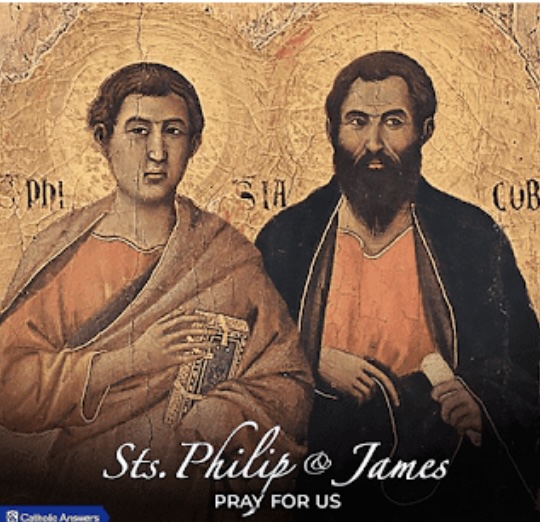
Today we are celebrating the feast of Saints Philip and James the Minor, Apostles of our Lord.
According to tradition, Philip was preaching the gospel in the Greek, Syrian, and Phrygia regions. The call of Philip is recorded in the Gospel of John. His hometown was Bethsaida. Andrew and Simon Peter were from the same town. Philip was already a disciple of John the Baptist before he followed Jesus. Philip brought Nathaniel to Jesus. In the narrative of the multiplication of loaves, it was Philip who asked Jesus how they could feed the five thousand, and it was he who told the Lord that they had but two loaves. He brought the Greeks to Jesus (cf. Jn 12:21). In the farewell discourse, he asked Jesus to show them the Father (cf. gospel reading). In the gospel of John Philip, he is one of the main characters.
The archaeologists have discovered the ‘Gospel of Philip.’ In yet another apocryphal (‘hidden’ or ‘unaccepted’) writing known as ‘Peter’s Letter to Philip,’ Peter invites Philip to join the apostles on the mount of Olives, because after Jesus’ resurrection, Philip on his own started proclaiming about Jesus – even before the Pentecost! In ‘the Acts of Philip’ we read about his works. It has been said that he was beheaded or crucified.
It was Philip who designed the Latin or Roman cross that we use in the liturgy and in our art. On the cross that Philip has are depicted two loaves of bread.
James the Minor is called so to differentiate him from James the Major, Son of Zebedee, Leader of the Jerusalem Church. James the Minor is presented as James, son of Alphaeus. Saint Hieronymus calls him ‘the brother of Jesus.’
What do we learn from these saints?
(a) Apostles are the bridges between Jesus and us. We see Jesus through their eyes; we touch Jesus through their hands. They are extensions of faith. In the first reading, Saint Paul tells the Church in Corinth that he has received and handed on the gospel. Paul underlines the responsibility of every believer that everyone who has received the gospel has the responsibility to pass it on. The gospel is both a gift and a task.
(b) Philip who dialogues. Philip is portrayed as someone who constantly goes out – ad extra – towards Jesus and others. He was not caught up in his own thoughts. He moved out. He was able to dialogue with anyone and was at peace with everyone. He wanted to know the Father. Though his search looks simplistic, his thirst is authentic.
(c) Perseverance till the end. The apostles persevered till the end. The opposite of perseverance is resistance. The apostles never returned to their old selves. They moved forward.
#
The ministry of proclamation is not reserved for the bishops, priests, and religious; every baptised individual who has received the gospel as a gift has the task of preaching it. (Jubilee A. D. 2025, bite 88)
Fr. Yesu Karunanidhi
Archdiocese of Madurai
Missionary of Mercy
 Yesu Karunanidhi
Leave a comment