Daily Catholic Lectio
Friday, 29 March 2024
Good Friday of the Lord’s Passion
Isaiah 52:13-53:12. Hebrews 4:14-16, 5:7-9. John 18:1-19:42
Three images
The readings that we heard during the celebration of the Lord’s Passion put forward three images: ‘suffering servant,’ ‘high priest,’ and ‘paschal lamb.’
(a) Suffering servant
The first reading is the fourth song of the suffering servant as recorded in the book of Isaiah, who prophesies these songs to the people of Israel who were in Babylonian exile. The expression ‘suffering servant’ may refer to ‘Isaiah,’ ‘Jehoiachin,’ or ‘the entire people of Israel.’ In the Christian reading, the ‘suffering servant’ is Jesus. We believe that Isaiah’s prophecy is being fulfilled in Jesus.
The suffering servant prefigures Jesus in four ways: (i) He experiences humiliation, rejection, and suffering. Jesus is being rejected by his own people, he is humiliated, and he undergoes pain. (ii) The suffering of the servant is vicarious, i.e., he suffers for the other or instead of the other. He, the just one, takes up on himself the suffering of the unjust one. Jesus, who is sinless, vicariously suffers for us who are sinners. (iii) The suffering servant does not react to those who inflict suffering on him. His silence is an expression of his patience, forgiveness, and magnanimity. (iv) Though the suffering servant undergoes suffering, God exalts him and raises him up. Jesus, who was crucified, was later raised to life by God.
The suffering servant teaches us the value of suffering. He does not guarantee a life that is free from suffering, but he invites us to practice resilience and silence.
(b) High priest
The image or word-picture depicted in the second reading is ‘high priest.’ The author of the Letter to the Hebrews presents Jesus as the Supreme High Priest. Jesus was not born of the tribe of Levi, nor was he congenial to chief priests during his ministry, and he underwent a humiliating death. However, the author calls him a High Priest in the order of Melchizedek, a high priest ‘who was faithful to God and compassionate to his brothers and sisters.’
The characteristic features of Jesus as the High Priest are: (i) He was tested like us in every way, as we heard from the gospel reading on the First Sunday of Lent; (ii) He cried to his Abba at Gethsemane that he would be relieved from suffering. (iii) Jesus was made perfect through his sufferings – the perfection of suffering achieved through resurrection.
The passion narrative, as we heard it recorded by John, presents Jesus as a high priest who solemnly dies on the cross. The last words of Jesus are: ‘It is accomplished.’ In fact, this was the greeting of the High Priest at the end of the celebration of the Day of Atonement. Jesus, on account of his own, gave up his life.
The author invites, “Let us confidently approach the throne of grace to receive mercy and to find grace for timely help.” Let us remember that today we have received grace and compassion from this great high priest and get rid of fear, guilt, and shame.
(c) The Lamb of God
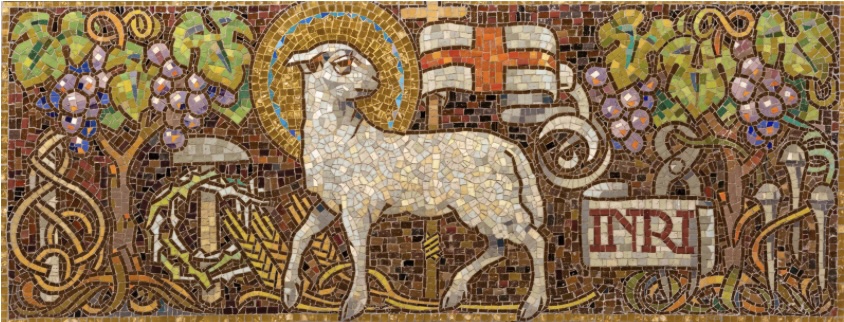
In the beginning of the gospel of John, when John the Baptist introduces Jesus to his disciples, he says, ‘He is the lamb of God … who takes away the sin of the world’ (cf. Jn 1:29). According to the gospel of John, Jesus is killed on the Jewish Passover day, and he dies exactly at the hour when in the Temple the High Priest will sacrifice the Passover lamb. In Jesus, the offeror and the offered are one and the same.
The expression ‘lamb of God’ reminds us about the celebration of Yom Kippur, the Day of Atonement. On this annual day of atonement (cf. Lev 16), the high priest will offer a bull for the expiation of his own sins. Then two goats will be brought before the high priest. He would cast on them. One will be taken into the Temple to be made as a sin offering for the people of Israel, whereas the other will be sent through the streets to the desert bearing the sins of all people. Jesus was like the goats of the day of atonement: like that goat that is offered, he too is offered; and like that goat that is sent out into the wilderness, i.e., calvary. This is what is prophesied by Prophet Isaiah: “Yet it was our infirmities that he bore, our sufferings that he endured.”
Saint Paul, writing to the Corinthians, metaphorizes Jesus as the Passover lamb: “Cleanse out the old yeast, for Christ, our Passover Lamb, has been sacrificed for us” (1 Cor 5:7).
What do we learn from these images or word-pictures?
(a) Resilience
The suffering servant is resilient till the end. He was able to fight back through his silence. At every moment of suffering, we grow to be better persons in our own eyes. It is necessary to be courageous.
(b) Compassion
The throne where Jesus is placed is not a throne of justice, but a throne of mercy and compassion. Though we are all condemned because of justice, we have been the recipients of his grace. The Lord Jesus forbears our shortcomings. We who receive mercy and compassion from him share it with each other.
(c) Forgiveness
Jesus has wiped away all our sins. He has removed ‘the sin of the world.’ We have received his mercy today. We will forgive ourselves and others.
Suffering servant, high priest, lamb of God – these images are being proclaimed in our liturgy. May they be proclaimed in and through our lives as well.
Fr. Yesu Karunanidhi
Archdiocese of Madurai
Missionary of Mercy
 Yesu Karunanidhi
Leave a comment