Daily Catholic Lectio
Sunday, 24 March 2024
Palm Sunday of the Lord’s Passion
Mark 11:1-10 (in Procession)
Isaiah 50:4-7. Philippians 2:6-11. Mark 14:1-15:47 (in Mass)
Three journeys
‘When Jesus and his disciples drew near to Jerusalem,’ thus begins the gospel reading that we heard at the procession. Together with Jesus and his disciples, we too enter Jerusalem today. For Jesus, Jerusalem was not the end. It meant a new beginning. It was from here that he gloriously ascended; it was here that he sent his apostles on mission, and it was here that the Church, the New Israel, was born.
The readings that we heard today put forward three journeys of Jesus: (a) Journey to Jerusalem; (b) Journey to Golgotha (Calvary); and (c) Journey to heaven.
(a) Journey to Jerusalem – ‘Hosanna’
Jesus himself initiates this journey. He chooses the mode of his travel – on the back of a donkey. It was told to the bystanders that the Master had a need for it. The disciples spread their cloaks on the colt, while the people spread their cloaks and leaves. Jesus, his disciples, and people all begin to act. The procession on the back of a donkey is noteworthy. The disciples of Jesus misunderstand Jesus to be the kingly Messiah who would bring forth political victory over the Romans. By choosing the colt of a donkey, Jesus tells them that his realm is spiritual and that what he wants is peace.
People rejoice and acclaim, “Hosanna! Blessed is he who comes in the name of the Lord! Blessed is the kingdom of our father David that is to come! Hosanna in the highest!” ‘Hosanna’ means ‘save us, please!’ or ‘come to liberate us!’ Jesus, who came on the borrowed donkey, was their last faith. They had hoped that Jesus would establish the kingdom of God. If we had participated in this procession during the time of Jesus, we too would have had this same faith and hope.
The first journey of Jesus symbolises simplicity, humility, faith, and hope. The people welcome Jesus to the city. They acclaim him with ‘Hosanna.’
(b) Journey to Golgotha – ‘Crucify him’
We heard the passion narrative of Jesus as recorded by the evangelist Mark. Jesus initiates the second journey as well. He sends his disciples ahead to prepare for the Passover. The journey to Golgotha comprises short journeys to Gethsemane, Sanhedrin, and Pilate.
The disciples who put their cloaks on the colt betray, deny Jesus, and run away from him. The people who cried out to Jesus with ‘Hosanna’ (‘come, save us’), were led into despair and hatred, and they cried to Pilate, ‘crucify him.’ They were disappointed because they had misunderstood Jesus.
The chief priests and the scribes are happy that they killed Jesus. Pilate feels happy because he has brought the chaos under control. Even though he knew that the chief priests and scribes had put Jesus to trial because of envy, he considered peace in Jerusalem during the feast his top priority. The centurion, who stood in front of the cross, confesses, ‘Truly, this man was the son of God.’
Though the journey is filled with emotions such as loneliness, hatred, humiliation, envy, and stubbornness, at the beginning and in the end there are some positive things to celebrate: an unnamed woman anoints the head of Jesus, and an unnamed soldier professes his faith in Jesus. The people’s acclamation is ‘crucify him.’
(c) Journey to heaven – ‘Jesus Christ is Lord’
The second reading gives us a wider vision of Jesus’ journey. Jesus journey in fact began in heaven and ended in heaven. Paul, who instructs the Church at Philippi to grow in humility, unity, and resilience through a Christological hymn, presents Jesus as the model. Jesus humbles himself, and God exalts him.
Jesus, who descended from heaven, ascended to heaven. He rose from the dead. God led him into glory. All people now acclaim, ‘Jesus Christ is Lord.’
As we enter Holy Week, let us remember all three journeys of Jesus. Faith, hope, loneliness, hatred, humiliation, betrayal, rejection, death, and sadness are part of our lives as well.
(a) ‘The Lord God is my help’
In the first reading, we heard from the third song of the Suffering Servant. The servant, who symbolises the people of Israel in exile, is rejected, humiliated, and condemned. But in the end, he realises that God was at his side as his help. Jesus, all throughout his life and passion, felt the presence of his father with him. This week, may we realise that God is with us.
(b) The cross
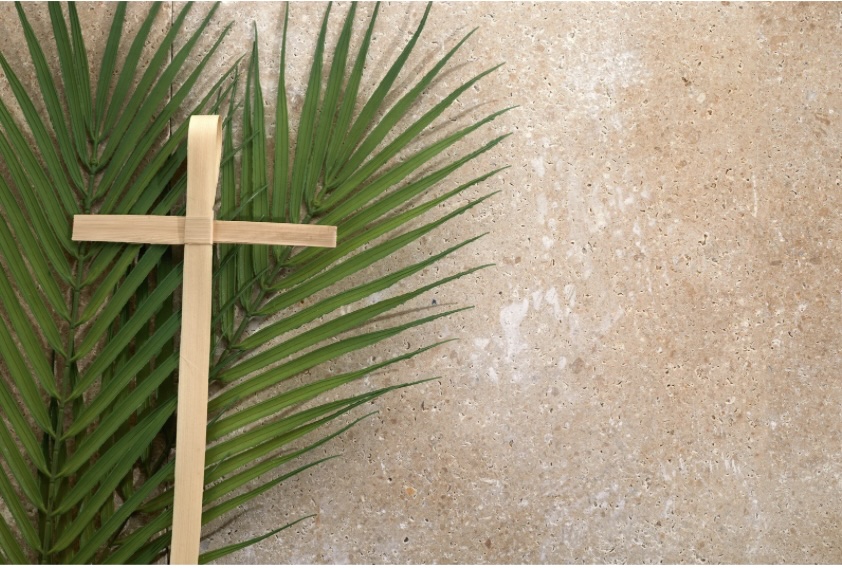
The palms that we hold today have become the cross. The smooth palm becomes the hard cross. Life is filled with palms and crosses. Through Jesus’ death, the cross, the symbol of humiliation, becomes the symbol of glory. Let us begin to accept the daily crosses of our lives.
(c) Change of heart or conversion
Our Mother Church recommends that we make a good confession in preparation for the celebration of Easter. Jesus died for our sins. We are called to die for our sins. Our repeated sins are our choices. Let us forgive ourselves and seek God’s forgiveness. Being reconciled with God, let us reconcile with each other.
Let us enter the Holy Week with the palms and the cross!
Fr. Yesu Karunanidhi
Archdiocese of Madurai
Missionary of Mercy
 Yesu Karunanidhi
Leave a comment