Daily Catholic Lectio
Sun, 17 March 2024
Fifth Sunday of Lent
Jeremiah 31:31-34. Hebrews 5:7-9. John 12:20-33
It bears much fruit!
Today’s liturgy of the word invites us to look beyond the cross. During the Lenten journey, we have been looking at the cross and reflecting on the passion and death of Christ. Let us raise our heads and see what lies beyond the cross and beyond the tomb.
In our lives, when we encounter suffering, loss, and loneliness, we feel that life is over. But, through suffering, loss, and loneliness, we are led into transformation, abundance, and fullness.
The first reading, taken from the Book of Jeremiah, brings to us the announcement of the New Covenant that the Lord establishes with the people of Israel. Prophet Jeremiah speaks to the people of Israel in Babylonian exile, who think that God has forgotten his covenant with them on Mount Sinai and his covenant with his servant David. The new covenant has three unique characteristics: (i) Unlike the Sinai Covenant, which was written on the tablets of stone, this will be written in the hearts of every individual; (ii) Unlike the earlier times when people had to teach about God, now everyone will know God within himself or herself; and (iii) This covenant will be ratified by God’s forgiveness and mercy.
Thus, the old covenant is being transformed into the new covenant. Jesus, at the Last Supper, institutes the Eucharist as a sign of the new covenant.
The people of Israel, who were away from God on account of their sin, are brought close to God.
The gospel reading has three parts: (a) Some Greeks come to see Jesus; (b) Jesus speaks about his death and discipleship; and (c) A voice from heaven acknowledges Jesus’ message. The word picture that is at the centre of the gospel is ‘a grain of wheat.’ Jesus uses an agricultural metaphor. During the time of Jesus, the principal crops in Palestine were wheat and barley. Sowing and ploughing happened simultaneously.
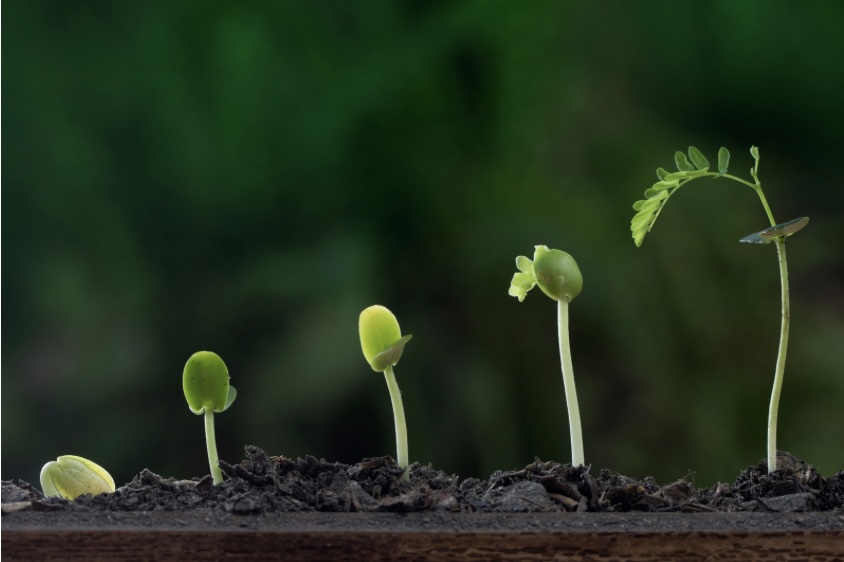
The grains of wheat that are sown on the ground must struggle to get inside the land; they must lose their whole selves and must come out with the same struggle. A grain of wheat that dies multiplies and grows to be abundant. It becomes food and nourishment for all.
Jesus suffers like a grain of wheat. He is buried like a seed. And he comes out of the tomb like a seed that blossoms. This is the glorification or exaltation of Jesus. When he is exalted, he draws all people to himself.
Thus, there is multiplication of grains and multiplication of disciples.
In the second reading, the author of the Letter to the Hebrews, after presenting Jesus as a faithful and compassionate High Priest, theologizes Jesus’ passion at Gethsemane and on the cross. He uses two liturgical words: ‘to offer prayers,’ and ‘to be made perfect.’
Jesus reaches perfection, or completion, through his passion.
Hence, The suffering of the people of Israel in Babylonia makes them enjoy the nearness of God through the new covenant. Jesus’ dying on the cross draws many people to himself. Jesus’ passion at Gethsemane and on the cross made him reach the completion of life.
‘It bears much fruit!’ Yes, our pain bears much fruit. Let us not lose this hope. How do we retain this hope?
(a) Experiencing the nearness of God
A rope that is torn and tied again brings the two ends closer. Our distance from God through our sins brings us closer to him through his forgiveness. His presence with us transforms us.
(b) Focusing on the victory, not on the battle
No one looks at the dying wheat, but people are attracted to the grains in the field. In the end, our struggles are not forgotten; only the fruits are remembered. Let us not be shortsighted because of our struggles or battles. It is not the beginning, but the end that matters.
(c) With loud cries and tears
Jesus’ cries and tears are a sign of his identity with humanity. Our loud cries and tears are natural when we are aiming for growth and fullness. It is necessary that we embrace cries and tears.
In the Responsorial Psalm (cf. Ps 51), King David asks the Lord, “Give me back the joy of your salvation.” The joy of salvation is our transformation, abundance, and fullness.
As Auguste Renoir, a French artist, remarks, “Pain passes, beauty remains.”
Fr. Yesu Karunanidhi
Archdiocese of Madurai
Missionary of Mercy

 Yesu Karunanidhi
Leave a comment