Daily Catholic Lectio
Sunday, 31 December 2023
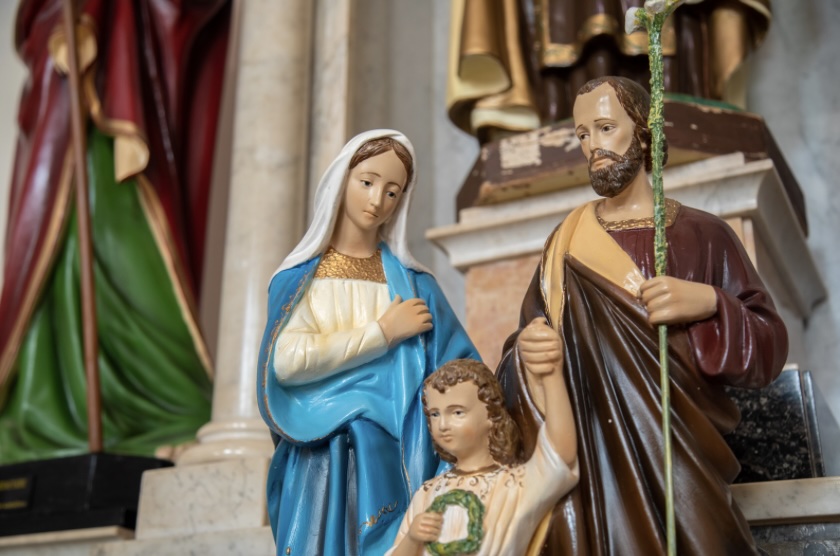
The Holy Family of Jesus, Mary, and Joseph
Genesis 15:1-6; 21:1-3. Hebrews 11:8, 11-12, 17-19. Luke 2:22-40
Family favoured by God
Certain tribes in Indonesia, Malaysia, India, and a few African countries have the custom of folding the umbilical cord of a new-born baby in a piece of cloth and tying it to a tree. Their belief is that God has given life to the baby and sent it into this world. Through this custom, the people communicate to God that life has reached the world safely and request that God further assist life here on earth.
In our tradition, we tonsure the heads of the new-born babies. Though it has hygienic and environmental rationale behind it, the religious significance is that through this gesture we offer the new-born baby to God. The king who is defeated in a war places his crown before the king who won over him. The hair, the crown of our heads, is being removed and is placed in front of God, who has won over us or redeemed us.
An African proverb reads, ‘It takes a village to rear a child.’ The feast of the Holy Family of Jesus, Mary, and Joseph tells us that ‘it takes God to rear a child.’
The gospel reading begins and ends with the word ‘Lord-God’: ‘the parents took Jesus to the Lord’… ‘The favour of God was upon him.’ The Holy Family of Nazareth goes to the Temple for two cultic reasons: (a) Purification of the mother after her childbirth—after 40 days if the child is male and after 80 days if the child is female (cf. Lev 12:1–9). (b) Redemption of the firstborn male, because every firstborn male belongs to God (cf. Exod 13:2, 13:15). The baby is placed in the hands of a Levite, who represents the Lord. Simeon, like a Levite, comes to hold the child in his hands.
The gospel reading points to the three characteristic features of the Holy Family:
(a) Submission to the Law of the Lord: Since Jesus was the Son of God and Mary bore in her womb the Son of God, they would not require redemption or purification. However, the Holy Family chose to submit themselves to the Law of the Lord.
(b) Poverty and simplicity: The parents of Jesus bring alone a pair of turtledoves or two young pigeons. This was the sacrifice prescribed for those who could not afford it (cf. Lev 12:6). The humble origins of Jesus are made manifest in his birth at Bethlehem and his dedication in Jerusalem. Paul writes, ‘Though he was rich, for your sake he became poor, that through his poverty you might become rich’ (cf. 2 Cor 8:9).
(c) Silence: In the narrative, we have the words of Simeon to God and to Mary. Anna thanks God and says about the child to those who awaited the redemption of Israel. But Mary and Joseph remained silent.
These three characteristic marks are the lessons for our families today: being submissive to the Law of the Lord, the Law, and the regulations of the Church; being simple in demeanour – often times we strive to make ourselves appear more than we really are; and being silent – give space for silence amidst our conversations and other noises that we have within and without.
The Holy Family that goes to Jerusalem returns to Nazareth. Here, we learn another lesson. Every family has two directions: one, towards God; and two, towards the house. The family that moves towards God fulfils the Law, and the family that comes home becomes favoured by God.
In the first reading, Abraham is impatient about God’s promise to him. He wants to make Eleazar his heir. But God reiterates his promise. The second reading narrates Abraham’s faith. Abraham’s faith and vision make him offer his son as a sacrifice to the Lord.
What are the lessons that we learn from the Holy Family?
(a) Being submissive to the will of God, being simple, and being silent – these shall be our characteristic marks.
(b) Our families should have two directions: to God and to our own homes.
(c) Our homes should be spaces for the growth of our bodies, wisdom, and spirituality.
Often times, we treat our homes as changing rooms and dormitories. Hardly do we spend time having conversations among the members. There is no time for God as well. When we go away from God, we go away from one another (cf. Gen 1:28).
#
The gospel reading portrays another type of family: that of Simeon and that of Anna. Simeon and Anna treat the entire world as their family, as their holy family.
Every one of us belongs to a family. Today, families are broken and separated due to war, natural disasters, poverty, and death. We are called to treat humanity and Nature as our family. This will liberate us from our narrowmindedness. We need to evolve a mindset that makes us see in a little child the light of God.
Humans make family. God makes it a holy family.
Fr. Yesu Karunanidhi
Archdiocese of Madurai
Missionary of Mercy
 Yesu Karunanidhi
Leave a comment