Daily Catholic Lectio
Thursday, 28 December 2023
Feast of the Holy Innocents
1 John 1:5-2:2. Matthew 2:13-18
Rescued like a bird
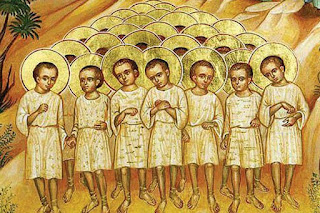
Matthew, who records the Infancy Narratives, presents the massacre of the innocent children (Gospel reading). When Herod realized that he had been deceived by the magi, he became furious. He ordered the massacre of all the boys in Bethlehem and its vicinity who were two years old and under.
When I was teaching the narrative of the massacre of the holy innocents to catechism class students, one of the kids asked me, ‘Father, why did not God save all the children that night?’ Her question still takes many forms: ‘Why did not God warn all the fathers to flee from Judea?’ ‘Why should many children be killed in order to protect one child?’ ‘How was John the Baptist spared?’ Can means justify an end?’
Herod, whom we encounter in the story, was called ‘Great’ for two reasons: he rebuilt the Temple of Jerusalem and embellished it; and he brought water to the city when there was famine in Judea. However, he was craving power. In view of retaining his power, he went to the extreme of killing his own sons.
Josephus Flavius, who has written a lot about Herod the Great, has not written a word about the event of the massacre of the innocents. He might not have considered it worth mentioning. Or he might not have been aware of it. According to the Catholic tradition, from six to twenty children might have been massacred; in the Greek tradition, about fourteen thousand might have been killed; and in the Coptic tradition, about one lakh forty-four thousand might have been killed. These numbers are mostly symbolic.
Some call this event literary and theological. It is a common literary feature to portray the child protagonist escaping when everyone else is killed. By doing so, the author portrays the protagonist as superior to others. When the Pharaoh killed the male children in Egypt, Moses alone escaped (cf. Exod 2:1-10). When the seventy sons of Gideon were killed, Jotham alone escaped (cf. Judg 9:3-6). Those who escape rule or lead the people. Here, Jesus alone escapes, and Jesus will be a ruler. Matthew writes this narrative as part of the fulfilment of the prophecies of Hosea (11:1) and Jeremiah (31:15). And we can read this narrative from the perspective of the passion narrative as well. The shadow of the cross begins to fall on Jesus at his birth itself. There is also a theology of rejection: Jesus is rejected by the Jews (Herod the Great) and accepted by the Gentiles (the wise men from the East).
How do we understand this feast?
(a) The reality of suffering. The reality of suffering in the world, both in the past and present, is cruel. The story of the Holy Innocents is a reminder of the brutality and injustice that can exist in our broken world.
(b) Herod’s fear. The Holy Innocents were killed because of Herod’s fear and insecurity. He saw the birth of the Messiah as a threat to his power. Herod forgot that his power is not unlimited.
(c) The light of Christ. Herod could not extinguish the candle of Christ. Light always shines forth amidst the darkness of violence.
(d) Honouring the Holy Innocents. The Holy Innocents represent the victims of violence throughout history. Any form of violence affects the vulnerable.
(e) Responding to injustice. The Holy Innocents invite us to respond to injustice. In front of power, the powerless suffer from injustice. A government that does not care about laying good roads is keen on charging its people for riding without helmets. A father of a sick child has to pay a fine of Rs. 500. He can’t question those who are in power. There, he is a holy innocent.
(f) Innocence of Christ. We can imagine the terror that the Holy Family faced that night. Jesus, as a human person, embraced human vulnerability, uncertainty, and ambiguity.
In conclusion, Matthew compares the event to the Babylonian exile: ‘Rachel cries out from her tomb.’
Amidst the sufferings of the Holy Innocents, Rachel still cries today. In today’s responsorial psalm, we sing, “Broken was the snare, and we were freed. Our help is in the name of the Lord, who made heaven and earth” (cf. Ps 124).
Fr. Yesu Karunanidhi
Archdiocese of Madurai
Missionary of Mercy
 Yesu Karunanidhi
Leave a comment