Daily Catholic Lectio
Monday, 25 December 2023
Nativity of the Lord – Mass during the Night
Isaiah 9:1-6. Titus 2:11-14. Luke 2:1-14
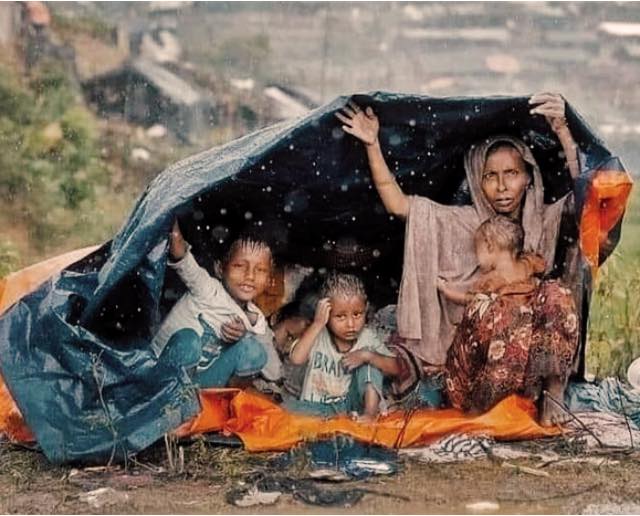
A few cribs last forever!
An image of a rainy evening. Along the roadside. Rain begins to fall in drops. A young mother in a faded handloom saree is squatting under a tarpaulin bag. A baby sitting on her lap holds on tight to her neck. Two kids are sitting next to the poor mother. The mother holds on to the tarpaulin bag tight, lest it fly off. The mother and the kids are not named. A line under the image reads in Italian: ‘A few cribs last forever!’ (‘Alcuni presepi durano tutto l’anno’)
Today we have decorated a beautiful crib at our church and in many of our homes. This year marks the 800th anniversary of Saint Francis of Assisi making the first live crib. Our Holy Father has announced plenary indulgence to everyone who visits a crib this year with prior preparation accompanied by the sacrament of reconciliation, making a profession of faith, and praying for the intentions of the Holy Father. Saint Ignatius of Loyola, in his Spiritual Exercises, proposes that the retreatant make a contemplative meditation sitting in front of a crib. Thus, a crib is a place for catechesis, faith formation, evangelization, and meditation. The crib draws us close to God and makes us close to each other.
As no God-made human person is identical, no man-made crib is identical. Each crib is unique. Every year, we make the crib with a different design. We don’t want to repeat what we did the previous year, nor do we want to make it as our neighbour’s home or church makes it.
We use our creativity to make the best crib possible. Inter-faith cribs, plastic cribs, plastic-free cribs, paper cribs, thermocol cribs, grass cribs, hay cribs, mud cribs, and wooden cribs. Once, a parish priest made a crib in his parish. Instead of placing the baby Jesus in the crib, he placed a mirror and wrote on it, ‘The baby Jesus is born in you.’ A lot of creativity is at work when we make the crib.
Whatever way we make the crib, we will all dismantle it. Every crib that is made will be removed. The crib that we have today will become the empty tomb of Jesus. The baby Jesus will be replaced with the Risen Lord.
But a few cribs last forever! A few cribs are never dismantled.
In the gospel reading of the day, Luke writes about the first crib at Jesus’ birth. A couple’s journey begins without booking a room in the inn or reserving a place. Joseph embarks on a journey with his wife, who was a child. Joseph comes to his own town, the town of David. From Galilee, Joseph, Mary, and the child in the womb move to Judea. God comes down to his own town. God comes to dwell among the people. John writes, ‘He came to his own’ (Jn 1:11). We all belong to him. He comes down to us. As Jesus’ first journey was from Galilee to Judea, his last journey will be from Galilee to Judea. Jesus, who was laid in the manger swaddled with clothes, will be laid on the cross naked. Jesus, who was born in the house of bread (‘Bethlehem’), will offer himself as the life-giving bread. ‘God with us’ in Bethlehem will return to God as ‘God for us.’
Luke records that Mary was with a child when she travelled. The taking of censuses makes the lives of poor people miserable. The power structures never consider the lives of the poor and the vulnerable.
When the time came for Mary to give birth, she brought forth Jesus and laid him in the manger. Luke writes the reason here: ‘there was no place in the inn.’ Archbishop Fulton Sheen comments on this: ‘On that day, the inn was full. There was a place for the ministers’ secretaries. There was a place for the governor’s soldiers and for the officials. But there was no place for the couple from Nazareth.’ When God came to his own, humanity rejected him. John further writes, ‘He came to his own, and his own did not receive him’ (Jn 1:11).
When there was no place in the inn, the couple moved to the cattle shed. They did not prove to the innkeeper who they were and how blessed they were to carry the Messiah of the world.
God does everything beautiful in his time (cf. Eccl 3:11). Space and time are God’s. God makes his son be born in the crib. The baby is wrapped in swaddling clothes and laid in the manger. ‘Manger, clothes, child’ – these are the three elements of the sign that the angel gives to the shepherds.
Even though there was no place for him in the inn, there was a place for him in the manger, and there were clothes waiting for him. The clothes of the first Adam must be worn by the second Adam.
Parallel to the event of Mary giving birth to a child, another event takes place.
Here is the cowshed. There is the open field.
Here Jesus illuminates the darkness of the cattle shed. There, the glory of God shines forth.
Here, the word is born. There, the word is announced.
Here, Joseph and Mary are awake. There, the shepherds are awake.
The shepherds in Jesus’ time were called liars, thieves, and the unclean. These people receive the first good news: “Behold, I proclaim to you good news of great joy that will be for all the people. For today, in the city of David, a saviour has been born for you, who is Christ and the Lord. And this will be a sign for you: you will find an infant wrapped in swaddling clothes and lying in a manger.”
In those days, the birth of the princes was announced as the good news.Jesus, the prince of peace, is born. And the message is announced as good news for all the people. The angel calls the child with three titles, ‘Lord, Messiah, and Saviour’, and says, ‘The child is born for you.’
The Messiah is born for those who wait for him. The first reading brings before us the prophecy of Isaiah to the troubled king Ahaz, who had to choose between Assyria and Egypt. God gave him the sign of Immanuel and the prophecy being fulfilled: “A child is born to us, a son is given us; upon his shoulder dominion rests. They name him Wonder-Counsellor, God-Hero, Father-Forever, Prince of Peace.’ In the immediate context, the child refers to Hezekiah. But in the Messianic reading, it refers to Jesus. God alone is forever. And he alone will be a father forever.
John continues, ‘But to all who did receive him, who believed in his name, he gave the right to become children of God’ (Jn 1:12). The same message is conveyed by the angels: “Glory to God in the highest and peace on earth to those on whom his favour rests.”
Saint Augustine, commenting on this text, writes, “Heaven does not belong to the geography of space, but to the geography of the heart. And the heart of God, during the Holy Night, stooped down to the stable: the humility of God is heaven. And if we approach this humility, then we touch heaven. Then the earth too is made new.” Only those who bend themselves before God can reach his presence.
‘God comes to his own town,’ ‘God owns the vulnerability of humanity,’ ‘God is rejected,’ ‘God becomes food for us,’ ‘Christ is clothed as the first Adam was clothed,’ ‘God’s glory shines forth’ – all these messages of Christmas are summed up in one line, which Paul writes to Titus: ‘the grace of God has appeared.’ It is not our merit, but his grace; it is not our efforts to know him, but his revelation.
The nativity of the Lord gives us the following lessons:
(a) Each one of us is a crib of God. The cribs that we make will be dismantled. Our lives are like a crib that is never dismantled. In our crib as well, we have our parents, like Joseph and Mary; our near and dear ones, like the shepherds; and our teachers, like the wise men from the East. Our crib may stink at times. However, God’s glory shines forth. Our life is the crib where we become totally vulnerable. Let us accept primarily the crib of our own lives.
(b) Our neighbour is a crib of God. God is present there as well. ‘The Word became flesh and dwelt among us’ (Jn 1:18). There is always an ‘us,’ not a ‘me.’ The world today is concerned more about ‘me.’ God, by taking human flesh, has brought dignity and respect to every human person. We need to celebrate Christ in every human person. The angel tells the shepherds, ‘The child is born for you.’ Everyone in the world is a person for us. We need to accept everyone with his or her own vulnerabilities.
(c) We are about to receive in the Eucharist the bread from heaven. Jesus continues to make every altar a manger. Every altar is a Bethlehem. The body of Jesus laid in the manger was laid on the cross to become food for all people. Today, whatever type of crib we make, Christ is not born there. Because he was born, he lived, died, and rose again. He is now living with us in the Eucharist. He will come again as the judge of the world. The cribs that we see here on earth point to the eternal crib that is in heaven. Christ is seated on the right side of the Father.
A few cribs last forever. In hospitals, orphanages, care homes, homes for the destitute, prions, refugee camps, bus stands, railway stations, and pavements. Cribs in these places survive any rain, storm, wind, cold, or oppression.
Joseph, though he came to his hometown, did not have a home there. Mary, though filled with the words of God that said the son who is to be born will be the son of the Most High, did not explain herself. They just move ahead.
Christmas invites us to move ahead, to move on, and to move forward. Towards one another.
Yes, a few cribs last forever!
Fr. Yesu Karunanidhi
Archdiocese of Madurai
Missionary of Mercy
 Yesu Karunanidhi
Leave a comment