Daily Catholic Lectio
Monday, 27 November 2023
Monday of the Thirty-Fourth Week in Ordinary Time
Daniel 1:1-6, 8-20. Luke 21:1-4
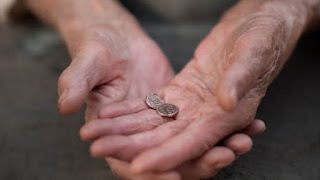
Two copper coins!
The episode of today’s gospel reading happens in the Jerusalem Temple. A woman puts two small copper coins (in Greek, two lepta; a lepton was a Jewish bronze or copper coin worth about 1/128 of a denarius, which was a day’s wage for a labourer). The woman offers the smallest amount, but that is all that she has. Jesus praises her act of kenosis (self-emptying).
We become angry when we think of the religion of Jesus’ time, which forced a poor widow to offer all that she had. Jesus, instead of questioning the structure that compelled the poor widow to make such an offering, praised her. Often, this text is used (or abused!) by us to draw people towards the dumb boxes. If the temple and the priests have to feed on the woman’s last two copper coins, do we still need the temple and the priests?
Luke introduces the woman in the gospel with three expressions:
(a) ‘She was poor’ … ‘out of her poverty’ – what is referred to here is her economic deprivation. The woman had nothing but these two copper coins. This expression tells us about her abject poverty.
(b) ‘She was a widow’ – the widows (together with orphans) are treated as the most vulnerable people since the time of Moses. Besides, in Jesus’ time, from a religious point of view, a widow was considered sinful and wretched because it was believed that because of her sins, her husband had to die.
(c) ‘She put in all she had to live on’ – the widow chooses to become a zero now. He has nothing to carry forward to the next day in her accounting journal. She would start her day with ‘zero balance.’ Her zero was the balance – balance of her life!
The widow teaches us that scarcity or abundance depends on who we are, not on what we have. If we say, ‘this is enough,’ this is enough. And if we say, ‘this is not,’ this is never enough. The widow becomes abundant through her total gift.
She converts money into value by offering it to God. By offering the copper coins to God, she converts them to gold coins!
In the background of the Gospel of Luke, wealth is the biggest obstacle to discipleship. The widow, by offering to God everything that she had, becomes a model for discipleship. She imitates Jesus, ‘who had no place to lay his head.’ She practices the Sermon on the Mount by ‘worrying not even about today.’
What is the lesson that we learn from this passage?
There are two types of giving: (a) ‘giving out of surplus,’ (b) ‘giving all that one has.’ The widow in the narrative is a metaphor for Jesus. This widow of Jerusalem offered her two copper coins. Jesus in Jerusalem will offer his two coins – body and spirit – totally! As the woman offered her two coins on the wooden offertory box, Jesus would offer his body and spirit on the wooden cross. Jesus’ offerings will tear down the curtains of the temple.
What are the two copper coins of our lives? Are we ready to give up what we have – totally?
In the first reading, Daniel, Hananiah, Mishael, and Azariah decline to eat the food prescribed by King Nebuchadnezzar. However, they grow ten times wiser than their companions in the king’s court. The young men chose to embrace what is right rather than what is easy.
#
The Catechism of the Catholic Church teaches us that the bread and wine that we offer at the Holy Mass represent our thanksgiving and surrender to the Creator (cf. n. 1333).
Fr. Yesu Karunanidhi
Archdiocese of Madurai
Missionary of Mercy
 Yesu Karunanidhi
Leave a comment