Daily Catholic Lectio
Friday, 24 November 2023
Friday of the Thirty-third Week in Ordinary Time
1 Maccabees 4:36-37, 52-59. Luke 19:45-48
Temple cleansed.
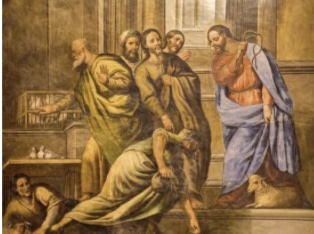
The first reading brings before us the cleansing of the Temple during the time of Maccabees, and the gospel reading portrays Jesus cleansing the Temple after his triumphal entry into Jerusalem.
In yesterday’s gospel reading, Jesus wept over Jerusalem as he drew near it. In today’s gospel reading, he enters the temple and cleanses it. The Temple was the centre, the head, and the summit of Jerusalem. The Synoptic Gospels present Jesus’ cleansing of the Temple at the end of Jesus’ ministry, while John presents it at the beginning of Jesus’ ministry.
During the time of Jesus, the custody of the temple was with the temple police, who were controlled by the High Priest and the chief priests. Some scholars say that it is highly improbable for Jesus to enter the Temple and send away the sellers and the money changers. Some scholars call this event theological, for it was believed that the Messiah, upon his arrival, would enter the Temple of Jerusalem and cleanse it. The gospel writers, thus, present Jesus as the Messiah.
Further, in Jesus’ time, the temple became a place of power, oppression, administrative abuses, and greed. A lot of taxation was imposed on the common people for the maintenance of the temple and the priests. The High Priest, whose control was the Temple, influenced politics as well. The Temple was in the hearts of the commonfolk, for they believed that the name of the Lord dwelt there. For this reason, the enemies of Jesus decided to do away with Jesus immediately after this event. Jesus’ cleansing of the Temple was one of the two accusations placed against him.
The gospel reading is divided into two parts: in the first part, Jesus enters the Temple and drives away the sellers; in the second part, his enemies are helpless because people cling on to him.
What does this even teach us?
(a) Purpose Digression
The purpose of the temple was to serve as a place of worship. In the course of time, people digressed from this purpose. The Temple began to become a place of commercial activities, injustice, and avarice. Saint Paul tells us that we are all temples of the Holy Spirit. If our body is the temple of the Holy Spirit, does it serve its purpose? Or has the purpose been digressed?
(b) Teacher and Teaching
Luke records that every day Jesus would teach in the Temple. The people who listen to Jesus’ teaching hold on to him. There was no gap between the teacher and the students. Is there a gap between our teaching and our being? Are there contradictions?
(c) Rightful anger
Jesus, on the one hand, underlines mercy, forgiveness, and compassion in his preaching; on the other, he comes heavily on those who oppress. He does not compromise with the wrong. Jesus’ rightful anger was directed at the oppressors, hoping they would experience a transformation. Do I compromise with my values? Or I stand for them.
In the first reading, the High Priest Mattathias cleanses the temple after overpowering the Seleucids, who made an abomination by offering swine meat on the altar. This inaugurates the new feast known as ‘Hanukkah.’
Though our body and mind are polluted, we too have a way of cleansing them, i.e., through the sacrament of reconciliation.
#
The Catechism of the Catholic Church exhorts on the holiness of life: “Justification by God involves two directions: we going towards him and forgiveness coming towards us. The end of human life is perfection or holiness” (cf. nn. 2018, 2029).
Fr. Yesu Karunanidhi
Archdiocese of Madurai
Missionary of Mercy
 Yesu Karunanidhi
Leave a comment