Daily Catholic Lectio
Thursday, 9 November 2023
Thursday of the Thirty-first Week in Ordinary Time
Ezekiel 47:1-2, 8-9, 12. 1 Corinthians 3:9-11, 16-17. John 2:13-22.
Dedication of the Lateran Basilica in Rome, Feast
We are the temple!
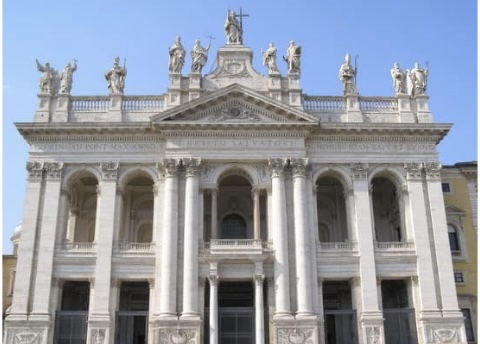
The Feast of the Dedication of the Lateran Basilica, also known as the Feast of the Dedication of the Basilica of St. John Lateran, is a liturgical celebration in the Roman Catholic Church. It commemorates the dedication of the Archbasilica of Saint John Lateran in Rome. The Basilica of St. John Lateran, also known as the Lateran Basilica, is the cathedral of the Bishop of Rome, who is the Pope. It is considered the mother of all churches in the Catholic Church.
The Basilica was built by the emperor Constantine and was dedicated in 324 AD by Pope Sylvester. The feast holds special significance as it marks the dedication of the Pope’s cathedral, symbolising the unity of the Catholic Church and the Pope’s role as the spiritual leader of the worldwide Catholic community.
The Basilica of St. John Lateran is one of the four major basilicas in Rome, along with St. Peter’s Basilica, St. Paul Outside the Walls, and St. Mary Major. These basilicas are of great historical and spiritual importance in the Catholic tradition.
The readings of the day drive home the meaning of ‘temple’ or ‘church.’
In the first reading (cf. Ezekiel 47), the prophet Ezekiel sees a vision of water flowing from the Temple of Jerusalem. It was said that when the people of Judah were led into Babylonian exile, God’s glory also left the city. Now the return of God’s glory to the Temple foretells the return of the people of Judah to their own land. The water that flows from the Temple gives life and healing. The level of water increases as it begins to flow. The Temple, thus, signifies growth, well-being, and life for all people.
In the second reading (cf. 1 Corinthians 3), Saint Paul uses two metaphors. Through the metaphor of ‘building’ he reminds the people of Corinth that they are united to each other in church as different blocks of the building are made into a unified whole. Further, using the metaphor of the ‘Temple of the Holy Spirit’, he invites them to the holiness of life.
The gospel reading (cf. John 2) portrays Jesus cleansing the Temple of Jerusalem. At the superficial level, Jesus is seen as cleansing the temple, but at the deeper level, he replaces the temple with his own body. He puts forward a shift in the understanding of the temple: ‘the temple is no more place-centred, but is person-centred.’
What are the lessons of the feast today?
(a) God dwells amidst us.
The temple, or church, is the visible presence of God, who is invisible. It represents God’s protection and accompaniment. The Psalms portray the longing of the people for God’s temple. The Psalms of Ascent invite us to be united with God and one another.
(b) Churches raise our minds and hearts.
The tall and gigantic churches raise our minds and hearts towards God. And in front of them, we realise our insignificance and simplicity.
(c) The church is the umbilical cord.
The church or the temple could be symbolised as an umbilical cord or a bridge that connects God and us. The relationship that begins with God at baptism continues till our death and after.
On this feast day of the dedication of the Lateran Basilica, let us recall the dedication of our own diocesan cathedrals and parish churches. And may we dedicate ourselves to God as his temples.
#
The Catechism of the Catholic Church instructs: “What the soul is to the human body, the Holy Spirit is to the body of Christ, which is the Church … The Holy Spirit makes the church ‘the temple of the living God.’” (cf. n. 797)
Fr. Yesu Karunanidhi
Archdiocese of Madurai
Missionary of Mercy
 Yesu Karunanidhi
Leave a comment